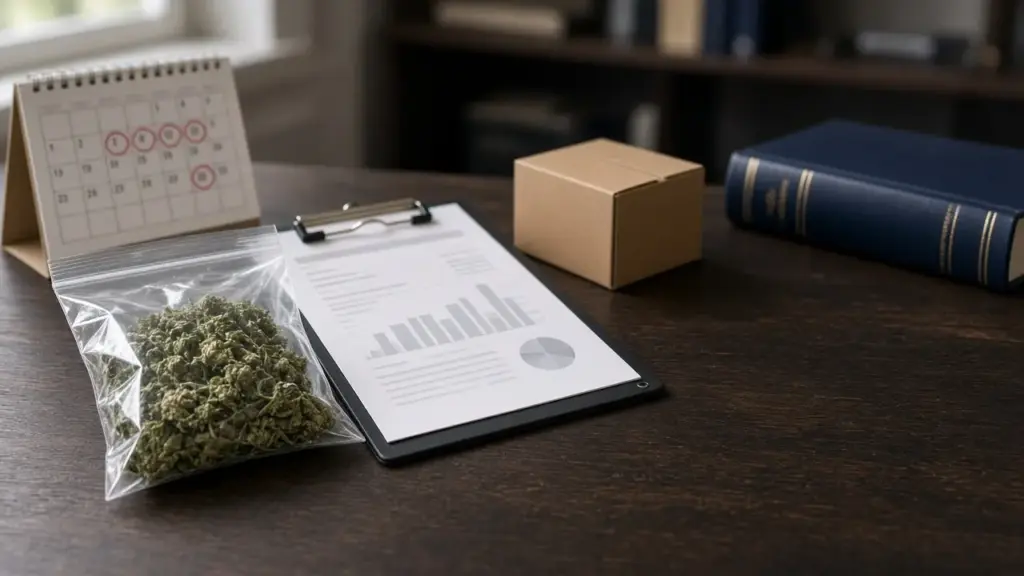
Federal hemp rules measure compliance at a specific moment. That moment is the pre-harvest hemp test, based on samples a sampling agent collects within 30 days before the producer harvests the crop. In a recent video, I explained why I believe that timing matters so much. If the plant material met the Farm Bill standard during that window, a later rise in THC should not change its legal status.
The THC level may have increased above 0.3 percent while the material was harvested, shipped, stored, and distributed. In my opinion, that fact alone is legally irrelevant. However, law enforcement and prosecutors do not agree with that approach. They hold up laboratory results from heated plant material, point to a figure such as 20 percent THC, and call the product 100 percent illegal. In some cases, they also describe a retail storefront as a front for drug dealing and charge everyone involved with felony Possession With Intent to Deliver.
I have already written about why gas chromatography results in THCA testing may mislead, and about the science of hemp testing after harvest. This article focuses on the legal argument itself. Where does federal law place the compliance measurement? Why do I think that measurement point should control? Also, how does that argument collide with a felony drug charge in Pennsylvania?
Where Federal Law Places the Pre-Harvest Hemp Test
The Farm Bill Definition of Hemp
The Agriculture Improvement Act of 2018, often called the 2018 Farm Bill, separated hemp from marijuana under federal law. Under the hemp definition in 7 U.S.C. 1639o, hemp is the plant Cannabis sativa and its derivatives with a delta-9 THC concentration of not more than 0.3 percent on a dry weight basis.
In short, that definition tells us what hemp is. It does not, on its own, explain when or how a laboratory should measure the plant. Congress left that work to the hemp production programs run by the United States Department of Agriculture and by approved state and tribal plans.
The 30-Day Window for the Pre-Harvest Hemp Test
The federal regulations answer the timing question directly. Under 7 C.F.R. 990.24, a producer licensed by the Department must have a sampling agent collect samples no more than 30 days before the anticipated harvest. The samples come from the flowering tops of the plant. Also, the producer may not harvest the crop before the sampling agent takes the samples.
State and tribal hemp plans follow the same basic rule. Section 990.3 of the regulations requires those plans to provide for sample collection within 30 days before the anticipated harvest. In addition, producers may not collect samples from their own growing facilities. A trained sampling agent has to do it.
The regulations also address the chemistry. Under section 990.25, the compliance test must use post-decarboxylation testing or another similarly reliable method. The testing method must consider the potential conversion of THCA into THC. The result must reflect the total available THC from the THC and THCA in the sample.
What Happens After a Lot Passes
After testing, the next step is just as important. Under 7 C.F.R. 990.26, the producer must harvest the crop no later than 30 days after the sampling agent collects the sample. If the producer does not finish harvest in time, the regulations require a second pre-harvest sample. Lots that meet the acceptable hemp THC level may then enter the stream of commerce.
Under section 990.24, producers also use post-harvest samples only for remediated biomass. In other words, the ordinary production system does not call for retesting the crop at every stop along the supply chain. The pre-harvest hemp test is the checkpoint the system relies on.
Why I Believe the Pre-Harvest Hemp Test Should Control
In my view, the argument is straightforward. The regulatory system decides whether a crop is hemp during the pre-harvest window. Once a lot passes and enters commerce, I do not believe a later change in its chemistry turns it back into a controlled substance.
Consider the path that plant material travels after harvest. First, someone dries, cures, trims, and packages it. Next, a carrier ships it to a distributor, which stores it. After that, it travels again to a retail store, where it may sit on a shelf for weeks. Time, heat, and storage conditions can affect how much THCA converts into delta-9 THC along the way.
Even so, none of that changes what the plant was during the compliance window. In fact, the pre-harvest hemp test already required the laboratory to account for the potential conversion of THCA. The system anticipated the same chemistry that prosecutors point to later. For that reason, a higher delta-9 THC number months later does not, in my view, prove much. It does not show that the crop failed the Farm Bill standard when it counted.
The Problem of Proof
There is also a practical problem with proof. A seized package in a retail store is a long way from the field where it grew. In many cases, I do not see how law enforcement can show that the plant material was anything other than lawful hemp 30 days before harvest. In a typical retail seizure, the government did not sample the field. It did not run a pre-harvest hemp test on the lot when the regulations required one. It tested something else, much later, for a different purpose.
The smoke shop owners I have spoken with have described a similar picture. They bought product from a supplier, received paperwork describing it as compliant hemp, and placed it on their shelves. A retailer usually has no way to go back in time and retest a crop that someone harvested months earlier in another state.
This Is an Argument, Not a Settled Rule
I want to be clear about one point. This is my opinion and my legal argument. It is not a settled rule that every court has adopted. Prosecutors read the law differently, and judges may decide the question in different ways. The outcome of any particular case depends on its facts, the charges, the court, and the law in effect at the time.
Why Prosecutors Look Past the Pre-Harvest Hemp Test
Instead of the field, prosecutors generally focus on the product as it existed when officers seized it. Their position is that the material in the store, not the crop in the field, is what matters. If that material tests above the legal limit, they treat it as marijuana.
In addition, they have a regulatory statement they can point to. The Department of Agriculture defines the acceptable hemp THC level for compliance with hemp production plans. Its own regulation states that this definition affects neither the statutory definition of hemp nor the federal definition of marijuana. Prosecutors may argue that production compliance and criminal liability are separate questions.
The Gas Chromatography Number
For example, the number they hold up usually comes from gas chromatography. That method heats the sample. The heat converts THCA into THC, so the result reflects total potential THC rather than the delta-9 THC already present in unheated flower. I explained this testing problem in detail in my article on THCA testing.
A result of 20 percent THC sounds decisive in a courtroom or a press release. However, a heated laboratory result taken after harvest answers a different question than the one the pre-harvest hemp test answered. In my opinion, that difference is the heart of these cases.
Pennsylvania Law Adds Another Layer
When Pennsylvania prosecutors file these charges, they rely on the state’s own drug law. The Pennsylvania Controlled Substance, Drug, Device and Cosmetic Act lists marihuana and tetrahydrocannabinols in Schedule I. The Act’s definition of marihuana is broad. Federal hemp compliance does not automatically answer every question under Pennsylvania law. I discuss the state picture further in my article asking whether THCA is legal in Pennsylvania.
The Storefront Theory
When prosecutors call a retail store a front, they are telling a story about intent. The story is that the hemp label was a cover and that the real business was selling marijuana. However, a licensed storefront with invoices, supplier paperwork, and certificates of analysis looks very different from a hidden drug operation. Even so, the label of “front” often appears in these cases, and it can shape how prosecutors file a charge.
What a Possession With Intent to Deliver Charge Requires in Pennsylvania
The most serious charge in many smoke shop cases is Possession With Intent to Deliver. Under Section 13(a)(30) of the Pennsylvania Act, codified at 35 P.S. 780-113(a)(30), it is unlawful for an unregistered person to manufacture, deliver, or possess with intent to manufacture or deliver a controlled substance.
For a Schedule I substance such as marihuana, section 13(f)(2) generally makes that offense a felony. The statute sets a maximum penalty of up to five years of imprisonment, a fine of up to $15,000, or both. Higher maximums apply to very large quantities. Those are statutory maximums. The sentence in any actual case depends on many factors, and a charge is not a conviction.
Still, the Commonwealth must prove each element beyond a reasonable doubt. That includes proof that the substance was a controlled substance under Pennsylvania law. It also includes proof that the person possessed it and intended to deliver it. A heated laboratory number does not, by itself, answer all of those questions.
When Prosecutors Charge Everyone in the Store
Prosecutors sometimes charge owners, managers, and clerks together. Employees may never have ordered, tested, or priced the product. In those situations, the Commonwealth may rely on constructive possession, which means control over an item that was not on the person. I have written about how habeas corpus challenges can test constructive possession before trial in Pennsylvania.
For that reason, each person charged deserves an individual look at the evidence. Working in a store is not the same as knowingly possessing a controlled substance with intent to deliver it. I have spent more than 24 years as a prosecutor and as a criminal defense attorney, and I do not accept a charging theory at face value.
The December 11, 2026 Change and the Pre-Harvest Hemp Test
Federal hemp law is changing. Congress amended the hemp definition in Public Law 119-37, enacted November 12, 2025. According to the Congressional Research Service summary of the new hemp definition, the new standard uses total THC, including THCA. The limit is still 0.3 percent on a dry weight basis.
However, Congress later delayed most of that change. As of the date of this article, the total THC standard is scheduled to take effect on December 11, 2026. Certain exclusions for cannabinoids that cannot be naturally produced by the cannabis plant took effect on November 12, 2026. Congress could change these dates again.
This timing matters for the argument I have described, including what a pre-harvest hemp test can show. My view about post-harvest THC changes is tied to the original Farm Bill definition, which measured delta-9 THC. Conduct that occurs after the new definition takes effect may face a different and stricter standard. The date of the alleged conduct, the product involved, and the law in effect at that time will all matter.
Questions to Ask About a Pre-Harvest Hemp Test Record
When hemp becomes the subject of a criminal case, I look at the full history of the product. For example, these general questions may matter:
- Can the seized product be traced to a specific harvested lot?
- Did that lot pass a pre-harvest hemp test within the 30-day window?
- Was harvest completed within 30 days after sampling?
- When, where, and how did law enforcement test the seized material?
- Did the laboratory heat the sample, and did it report delta-9 THC and THCA separately?
- Which federal and Pennsylvania definitions applied on the date of the alleged conduct?
Of course, the answers vary from case to case. Some records may support a defense, while others may raise new questions. Either way, I examine the law and the evidence together.
Frequently Asked Questions
Does a pre-harvest hemp test protect a product forever?
Not necessarily. In my opinion, a passing pre-harvest test should define whether the crop was lawful hemp, and later chemical changes should be legally irrelevant. However, prosecutors disagree, courts may view the issue differently, and state law and later changes in federal law can also affect the analysis.
Can THC levels change after hemp is harvested?
Yes. THCA can convert into delta-9 THC over time, and heat speeds that process. Storage conditions, time, and handling can all play a role. That is one reason the federal compliance rules require the test to account for the potential conversion of THCA.
Why do prosecutors rely on gas chromatography results?
Gas chromatography is a common laboratory method for measuring THC. The method heats the sample, which converts THCA into THC. The result therefore reflects total potential THC, which can be far higher than the delta-9 THC in unheated flower.
Is selling THCA flower automatically Possession With Intent to Deliver?
No. The Commonwealth must prove every element of the offense beyond a reasonable doubt. That includes proof that the product was a controlled substance under Pennsylvania law and that the person possessed it with intent to deliver it.
Can store employees be charged in a THCA case?
They can be charged, and prosecutors sometimes charge everyone working in a store. However, a charge is not proof. Therefore, the defense should examine each person’s knowledge, role, and connection to the product separately.
Will the December 11, 2026 federal change affect these cases?
It may. The new federal definition uses total THC, including THCA, for conduct after it takes effect. Cases based on earlier conduct may still turn on the original delta-9 THC definition. Congress could also revise the timeline again.
Are you or your business facing a hemp, THCA, or marijuana investigation in Pittsburgh or Western Pennsylvania? I can review the testing, the timeline, and the charges with you. You can read more about my Pennsylvania drug defense practice. You can schedule a free consultation to talk about your situation.
This article is for general informational purposes and is not legal advice. Reading it does not create an attorney-client relationship. Legal outcomes depend on the facts and circumstances of each case.