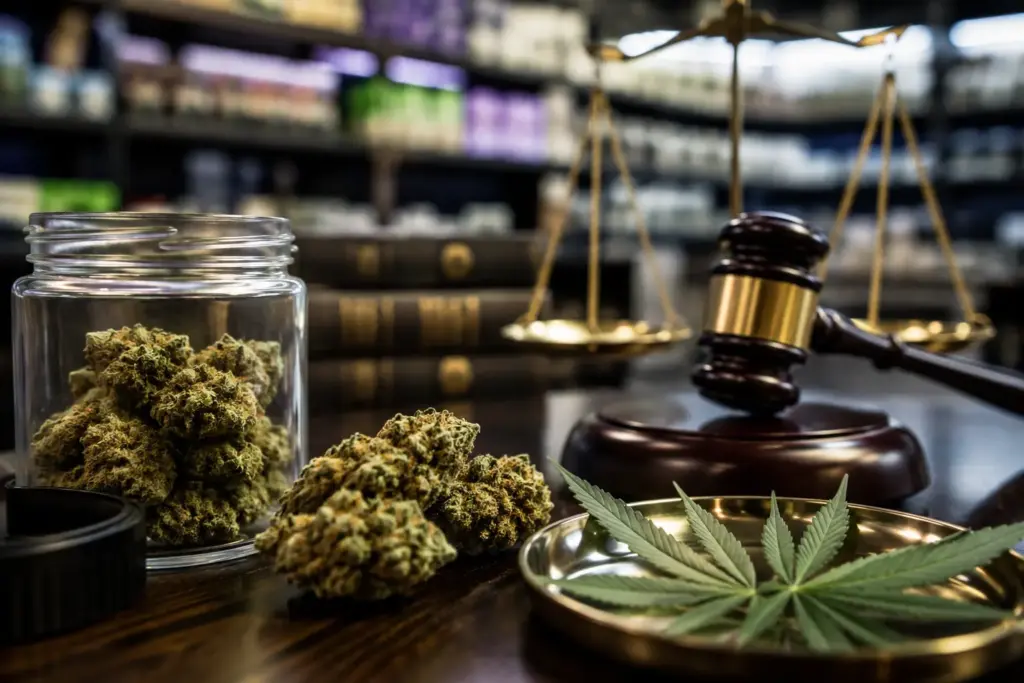
THCA products have become common in Pennsylvania smoke shops, convenience stores, and online stores. Many packages describe the products as hemp or “Farm Bill compliant.” That raises an important question: Is THCA legal in Pennsylvania?
The answer is more complicated than a product label may suggest.
Federal hemp law, Pennsylvania law, laboratory testing, and the chemical makeup of a product can all affect its legal status. Timing also matters. Congress has enacted significant changes to federal hemp law that are currently scheduled to take effect on November 12, 2026.
For someone facing a criminal investigation, the issue is not simply whether a store sold the product. Police and prosecutors may also focus on what the substance actually contained, how it was tested, and which law applied on the date of possession.
What Is THCA?
THCA stands for tetrahydrocannabinolic acid. It is a cannabinoid that occurs naturally in cannabis.
THCA is chemically different from delta-9 tetrahydrocannabinol, commonly called THC. However, heating THCA can convert a portion of it into delta-9 THC. As a result, cannabis flower with substantial THCA may produce intoxicating effects when smoked or vaporized.
This chemistry helped create a market for products commonly called THCA flower.
Some cannabis flower has been marketed as hemp because its measured delta-9 THC concentration falls within the current federal definition of hemp. At the same time, the flower may contain considerably more THCA.
That distinction is one reason the question of whether THCA is legal in Pennsylvania cannot always be answered by looking at one number on a package.
Why Does the Farm Bill Matter?
The Agriculture Improvement Act of 2018 established the modern federal distinction between hemp and marijuana.
Under the federal definition currently in effect, hemp generally includes Cannabis sativa and covered derivatives with no more than 0.3 percent delta-9 THC on a dry-weight basis.
That definition helped create a national market for hemp and hemp-derived products. It also created legal questions surrounding products that contain intoxicating cannabinoids while remaining below the statutory delta-9 THC threshold.
PKN Law discusses the broader legislative changes in more detail in Federal Hemp Law Changes in 2026.
The issue addressed here is narrower. What happens when a Pennsylvania consumer buys THCA from an ordinary retail store believing the product is legal hemp?
Does 0.3 Percent Delta-9 THC Automatically Make THCA Legal?
Not necessarily. A package that claims to contain no more than 0.3 percent delta-9 THC does not settle every legal question.
Federal rules governing hemp production already take THCA into account. The United States Department of Agriculture requires compliance testing that measures total THC and considers the potential conversion of THCA into THC.
According to the Department’s hemp laboratory testing guidelines, testing must use post-decarboxylation or another reliable method that accounts for the potential conversion of THCA into delta-9 THC. The results are reported on a dry-weight basis.
This creates an important distinction between a retail product label and the regulatory requirements that applied when hemp was produced.
A finished product may advertise a low delta-9 THC concentration. However, hemp crops are subject to a regulatory testing system that considers THCA when evaluating total THC.
Therefore, “less than 0.3 percent delta-9 THC” should not automatically be read as “legal under every law and in every situation.”
Is THCA Legal in Pennsylvania Right Now?
Pennsylvania law adds another layer to the analysis. Pennsylvania defines industrial hemp as Cannabis sativa and any part of the plant with a delta-9 THC concentration of no more than 0.3 percent on a dry-weight basis. The definition appears in Pennsylvania’s Industrial Hemp Act.
However, Pennsylvania also has separate controlled substance laws and a regulated medical marijuana program.
Recreational marijuana has not been legalized statewide. PKN Law explains that issue further in Is Marijuana Legal in Pennsylvania?.
Therefore, the legal status of a particular THCA product may depend on its cannabinoid content, its source, how it was tested, and the law prosecutors believe applies.
Broad statements such as “THCA is legal in Pennsylvania” can miss those important details.
Can You Be Charged for THCA Bought at a Smoke Shop?
Potentially. Buying THCA from a smoke shop does not create automatic protection from a police investigation or criminal charge.
Consider what may happen during a traffic stop. An officer finds cannabis flower in a vehicle. The package says THCA hemp. The purchaser explains that it came from a local smoke shop.
The officer may still seize the substance and request laboratory testing.
THCA flower can resemble marijuana in appearance and odor. Police officers may not be able to determine its chemical composition during a roadside encounter.
However, seizure or arrest does not establish guilt.
If prosecutors claim that a product sold as hemp was actually an illegal controlled substance, they still have to prove the elements of the charged offense.
PKN Law’s Pennsylvania drug defense practice addresses many of the evidentiary and constitutional issues that can arise in controlled substance prosecutions.
In a THCA case, the defense may need to examine both the scientific evidence and how police obtained the product.
Does Buying THCA From a Store Matter?
It can. A retail purchase does not determine the chemical makeup of the product. A receipt also does not transform an illegal substance into a legal one.
Still, the circumstances of the purchase may be important.
Suppose a consumer walks into an established store. The product is openly displayed. The package identifies it as hemp. The seller represents it as federally compliant. The customer receives a normal retail receipt.
Those facts may help explain how the person obtained the product and what the purchaser was told about it.
The importance of that evidence depends on the specific offense and circumstances.
Anyone facing an investigation involving retail THCA should preserve available evidence, including:
- The original packaging
- The store receipt
- A certificate of analysis
- Online purchase records
- Product photographs
- Information identifying the seller
Do not alter or destroy potential evidence.
Why Laboratory Testing Matters in a THCA Case
Laboratory testing may become one of the most important parts of a criminal case involving THCA.
Cannabis flower cannot always be legally classified by sight or smell. A laboratory can measure the cannabinoids contained in a sample and their concentrations.
That can lead to important questions.
- Did the laboratory measure delta-9 THC separately from THCA?
- Did it calculate total THC?
- Was the test quantitative, or did it simply indicate that a particular cannabinoid was present?
- Was the concentration reported on the basis required by the applicable law?
- Was the correct sample tested?
- Was the chain of custody properly documented?
These questions matter because cannabinoid testing is more technical than simply determining whether “THC” is present.
The United States Department of Agriculture requires validated analytical methods for federal hemp compliance testing. Its guidance also requires consideration of measurement uncertainty and the potential conversion of THCA into THC.
A laboratory report should therefore be examined carefully. Scientific terminology on a report does not automatically establish every element of a criminal offense.
Federal THCA Rules Are Scheduled to Change
Federal hemp law is scheduled for a significant change on November 12, 2026.
Congress enacted a narrower definition of hemp that moves away from focusing solely on delta-9 THC.
The amended definition addresses total tetrahydrocannabinols and places additional restrictions on certain hemp-derived cannabinoid products.
A federal rule published in the Federal Register confirms that the amended definition is scheduled to take effect on November 12, 2026. It also explains that hemp products satisfying the current 2018 definition remain outside federal controlled substance treatment through November 11, 2026, assuming compliance with other applicable federal laws.
The official federal publication is available through the Federal Register’s discussion of the 2026 hemp changes.
For high-THCA flower, that change may be significant.
Products marketed based on a low delta-9 THC concentration may face a different legal analysis once the new federal framework applies.
Why the Date of Possession May Matter
Changing laws make the date of an alleged offense particularly important.
A product possessed before a new statutory definition takes effect may be evaluated under different federal language than a similar product possessed later.
That is one reason consumers should be cautious about relying on old packaging, social media posts, certificates, or articles discussing THCA.
The law may have changed since the information was published.
The same principle applies in a criminal case. An attorney should examine the law that was actually in effect when the alleged conduct occurred rather than applying a later definition retroactively.
Federal Law and Pennsylvania Law Are Different
Another common misconception is that compliance with federal hemp law automatically resolves Pennsylvania criminal law.
It does not.
Federal law and Pennsylvania law are separate. Both may become relevant to a cannabis-related case.
Pennsylvania regulates industrial hemp while also maintaining controlled substance laws and a medical marijuana program. The Commonwealth has not adopted statewide recreational marijuana legalization.
Consequently, a defense involving THCA may require an analysis of both state and federal law.
The facts matter as much as the label.
Can You Drive After Using THCA?
The legality of purchasing or possessing a product is separate from the legality of driving after using it.
A hemp-derived product may still cause intoxication.
Someone should not assume that a “legal hemp” label protects against a driving under the influence investigation.
Pennsylvania has separate laws concerning driving after using drugs or controlled substances. A case may involve blood testing, cannabinoid metabolites, officer observations, statements, and the circumstances surrounding the traffic stop.
More information is available through PKN Law’s Pennsylvania DUI defense practice.
The safer approach is straightforward. Do not drive when a cannabis or hemp-derived product may impair your ability to operate a vehicle safely.
What Should You Do If Police Seize THCA?
If police seize a THCA product that you believed was legal hemp, avoid trying to provide your own legal or scientific analysis during the encounter.
Do not guess about THC concentrations.
Do not assume that telling an officer the product came from a smoke shop will resolve the issue.
Instead, preserve the packaging, receipts, laboratory certificates, and other documentation connected to the purchase.
A criminal defense attorney can then examine several issues.
- Was the search lawful?
- What substance was actually seized?
- How did the laboratory test it?
- What did the test establish?
- Which statute is the prosecution relying upon?
- Was the product actually possessed by the person charged?
- Was there evidence of personal possession or alleged distribution?
These questions may be more important than the marketing language printed on the package.
THCA Cases Require a Fact-Specific Analysis
The question “Is THCA legal in Pennsylvania?” sounds as though it should have a simple yes-or-no answer.
In practice, the answer can depend on the product.
Two packages labeled THCA may have very different cannabinoid concentrations. They may come from different producers. They may have different laboratory reports. They may also be possessed at different times under different versions of federal law.
That is why criminal cases involving THCA should be evaluated based on the actual evidence.
Patrick Nightingale has more than 24 years of experience as both a former prosecutor and criminal defense attorney. He represents clients in Pennsylvania state and federal criminal matters, including cases involving marijuana, controlled substances, distribution allegations, and driving under the influence.
If you are facing a THCA, marijuana, hemp, or other drug-related investigation, you can contact PKN Law to schedule a consultation or call (412) 454-5582. The firm’s contact page confirms the consultation information and current telephone number.
A product labeled “Farm Bill compliant” may be relevant evidence. It is not necessarily the complete legal answer.
This article is provided for general educational purposes and does not constitute legal advice for an individual case. Hemp law continues to change, so the law applicable on the date of the alleged conduct should be reviewed.