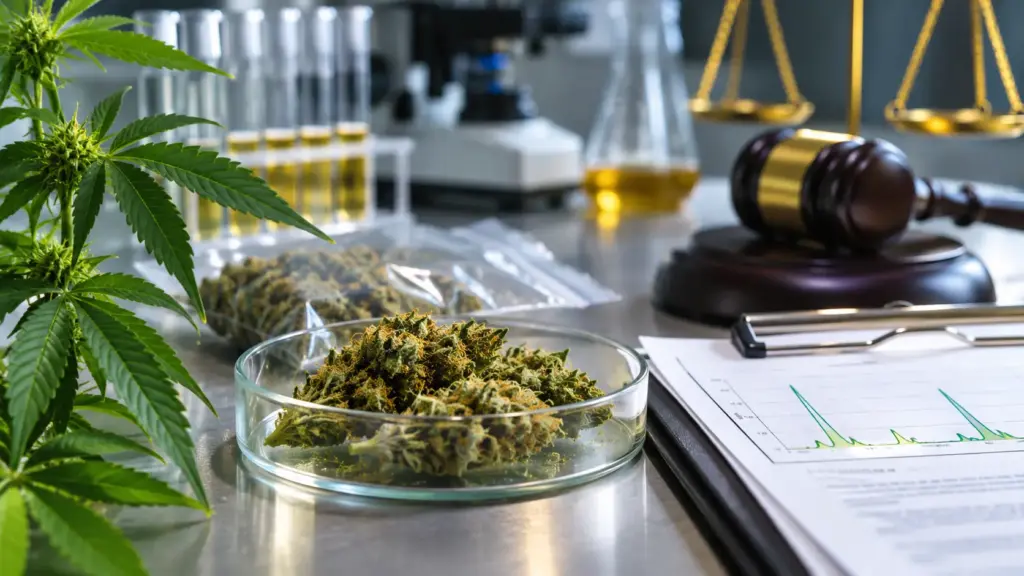
One of the most interesting questions surrounding federal hemp law involves what happens after a legally cultivated hemp plant has been tested and harvested.
Under the 2018 Farm Bill, Congress established a legal distinction between hemp and marijuana based primarily on the concentration of delta-9 tetrahydrocannabinol, commonly known as THC. That distinction changed the legal treatment of cannabis products throughout the United States.
However, there is an important detail that is often overlooked. Federal hemp production regulations generally require compliance testing before harvest, not continuous testing throughout the life of the harvested material.
Why does that matter?
Because cannabis is a plant, and its chemical composition can change over time. Heat, storage conditions, and the natural conversion of tetrahydrocannabinolic acid, or THCA, into THC can influence what a laboratory measures months after harvesting.
The resulting legal questions are more complicated than simply looking at a number on a laboratory report.
Having spent more than 24 years as both a prosecutor and criminal defense attorney, I understand how important it is to examine exactly what the law requires and what the government’s evidence actually proves.
What Does the 2018 Farm Bill Require for Hemp Testing?
The Agriculture Improvement Act of 2018, commonly known as the 2018 Farm Bill, removed qualifying hemp from the federal Controlled Substances Act’s definition of marijuana.
Under the original statutory definition, hemp included cannabis and its covered derivatives containing no more than 0.3 percent delta-9 THC on a dry-weight basis.
Congress also established a framework for regulating hemp production. The United States Department of Agriculture subsequently developed rules addressing licensing, sampling, testing, and other compliance requirements.
One of those requirements involves the timing of THC testing.
Under Title 7, Section 990.24 of the federal regulations, producers licensed directly by the Department of Agriculture must have an authorized sampling agent collect samples no more than 30 days before the anticipated harvest.
The samples are collected from specified portions of the hemp plant and analyzed to determine whether the crop satisfies the acceptable THC concentration level.
The producer must generally complete harvesting within 30 days after sample collection. If that period expires before harvesting is completed, another pre-harvest sample is required.
These requirements are intended to establish whether the hemp crop complies with federal production rules.
I believe this distinction is especially important when considering how hemp becomes evidence in a criminal investigation.
A regulatory test conducted before harvest and a forensic test conducted after law enforcement seizes a product are not necessarily performed for the same purpose.
Is Hemp Required to Be Tested After Harvest?
This is where federal hemp law becomes particularly interesting.
Under the ordinary federal production rules, a hemp crop that satisfies the applicable pre-harvest testing requirements generally does not have to undergo routine additional testing simply because it has been harvested and placed into storage.
In fact, Title 7, Section 990.26 provides that hemp lots meeting the acceptable THC level may enter the stream of commerce.
That does not mean all post-harvest testing is prohibited or unnecessary. Federal regulations provide for post-harvest sampling in certain circumstances, including remediated hemp biomass. Other federal and state requirements may also apply.
Nevertheless, the ordinary production compliance process focuses on testing the crop before harvest.
Consider what this means for a legally cultivated hemp crop.
A producer obtains the required laboratory analysis. The crop satisfies the applicable regulatory standard. The plants are harvested and placed into storage before eventually being transported or sold.
The original testing documentation may establish that the crop complied with federal production requirements at the time it was sampled.
However, what happens if the chemical composition of that material changes afterward?
That question requires an understanding of cannabis chemistry.
How Does THCA Convert Into THC After Harvest?
Cannabis naturally contains multiple chemical compounds known as cannabinoids.
Two important cannabinoids for purposes of this discussion are THCA and delta-9 THC.
THCA is a naturally occurring precursor to delta-9 THC. Through a chemical process called decarboxylation, THCA can convert into delta-9 THC.
Heat accelerates this process.
That is why heating cannabis through smoking, vaporization, or cooking can change its chemical composition.
However, decarboxylation is not limited to intentional heating.
Some conversion may also occur during storage, depending on temperature, time, and environmental conditions.
For example, consider harvested hemp stored in a warehouse during the summer.
If temperatures remain elevated for an extended period, some of the THCA in that material may gradually convert into delta-9 THC.
As a result, a laboratory examining the material several months later could identify a different concentration of delta-9 THC than was measured earlier.
The important scientific distinction is that converting THCA into delta-9 THC does not necessarily increase the total potential THC in the material.
Instead, the relationship between the two cannabinoids changes.
Federal agricultural testing already accounts for this potential conversion.
According to the United States Department of Agriculture’s hemp testing guidance, compliance testing uses post-decarboxylation methods or similarly reliable procedures to determine total potential THC.
The calculation may account for the THC that could result from the conversion of THCA.
In other words, the original compliance test is not necessarily limited to measuring only the delta-9 THC already present in the plant.
That detail becomes important when evaluating whether a later increase in measured delta-9 THC actually establishes anything about the plant’s original compliance.
Can Hemp That Was Legal at Harvest Become Illegal Later?
This is the legal question that deserves careful examination.
Suppose a licensed producer grows hemp and obtains a compliant pre-harvest test.
The crop is harvested and stored.
Months later, law enforcement seizes some of the material and submits it for forensic testing.
The laboratory identifies a delta-9 THC concentration exceeding the threshold applicable under a particular statutory definition.
Does that mean the producer or distributor necessarily committed a crime?
No. A laboratory result by itself does not establish every element of a criminal offense.
However, I would not suggest that a compliant pre-harvest test provides permanent legal protection regardless of what happens to the material afterward.
The analysis requires several important distinctions.
First, the law governing agricultural production is not necessarily identical to the law governing possession or distribution.
Second, a particular product may be subject to additional state or federal requirements.
Third, the legal definition of hemp must be evaluated as it existed at the time of the alleged conduct.
Finally, the government must establish the elements of the specific offense charged.
From a criminal defense perspective, the pre-harvest compliance records may be significant evidence.
They may help establish where the product originated, how it was initially classified, and whether it was produced within the applicable regulatory framework.
They do not necessarily resolve every subsequent legal question.
Individuals facing allegations involving cannabis products may benefit from understanding the distinction between lawful hemp and controlled marijuana. I have addressed the broader statutory issues in my article on the 2018 Farm Bill and cannabis laws.
Why the Timing and Method of THC Testing Matter
Throughout my career, I have seen how scientific evidence can shape a criminal prosecution.
Drug cases often depend heavily on laboratory findings. Prosecutors may rely on those findings to establish the identity or composition of an alleged controlled substance.
However, every laboratory result must be evaluated in context.
When a case involves hemp, I want to know exactly what the laboratory tested, how the sample was collected, and which cannabinoids were measured.
I also want to understand whether the laboratory reported delta-9 THC alone or calculated total potential THC.
Those measurements are related, but they are not interchangeable.
The distinction can become particularly important when comparing a pre-harvest compliance report with a later forensic report.
Different Samples May Produce Different Results
Hemp plants are not chemically uniform.
Cannabinoid concentrations can vary between different portions of a plant, between plants in the same field, and between individual samples of harvested material.
An agricultural compliance sample may therefore differ from a sample later collected from stored or processed hemp.
That difference does not automatically establish that either test is unreliable.
It does mean that the relationship between the samples should be carefully examined.
Storage Conditions Can Affect the Evidence
The conditions under which hemp is stored may also be relevant.
Temperature, duration of storage, and exposure to environmental conditions can influence the chemical composition of cannabis material.
If the government relies on a laboratory result obtained long after the alleged offense, a defense attorney may need to examine whether the tested sample accurately represents the material at the relevant time.
It would be equally important to determine whether there is scientific evidence supporting a claim that storage affected the results.
I do not believe it is appropriate to assume that a laboratory finding is incorrect simply because the material was stored for several months.
The question is whether the testing and available evidence support the conclusions the government wants the court or jury to draw.
The Chain of Custody Is Important
The chain of custody documents how evidence was collected, transported, stored, and analyzed.
In cannabis cases, that information can become significant.
For example, if law enforcement collects multiple packages of suspected marijuana, it may be important to determine which packages were sampled and whether the tested material can reliably be connected to the alleged offense.
The preservation and handling of those samples may also warrant examination.
Questions about the chain of custody do not automatically invalidate a laboratory report. Nevertheless, they may affect how the evidence is interpreted or weighed.
My approach is to examine the entire evidentiary record rather than relying on a single laboratory conclusion.
What Does a Hemp Certificate of Analysis Actually Prove?
Hemp producers and distributors frequently maintain certificates of analysis documenting the chemical composition of their products.
These records may identify the testing laboratory, the date of testing, the sample analyzed, and the reported cannabinoid concentrations.
Such documentation can be important when a product becomes the subject of a criminal investigation.
However, a certificate of analysis is not a universal legal authorization to possess or distribute cannabis.
The certificate must be connected to the particular material involved in the case.
A defense attorney may need to determine whether the seized product came from the batch identified in the report and whether the testing addressed the relevant statutory requirements.
The timing of the test may also matter.
For a person accused of possessing marijuana, evidence that the material was marketed and documented as compliant hemp may provide useful context.
Whether that evidence supports a particular legal defense depends on the facts and applicable law.
These questions overlap with the issues I discuss in my article addressing whether THCA is legal in Pennsylvania.
Federal Hemp Law Is Changing in 2026
There is another important consideration for anyone involved in the hemp industry.
Congress has amended the federal definition of hemp, with significant changes scheduled to take effect in November and December 2026.
Under the original 2018 Farm Bill definition, the federal statutory threshold focused on delta-9 THC.
The revised framework includes a broader total THC standard that expressly accounts for THCA. It also imposes additional restrictions on certain hemp-derived cannabinoid products.
Although many of these changes were originally scheduled for November 12, 2026, Congress delayed the effective date of most provisions until December 11, 2026.
Certain exclusions involving products containing cannabinoids that cannot naturally be produced by the cannabis plant are still scheduled to take effect November 12, 2026.
The Congressional Research Service’s October 28, 2026 analysis explains these legislative changes and their implications.
This matters because the legal status of a cannabis product may depend on when the alleged conduct occurred.
A product evaluated under the original 2018 Farm Bill definition may present different legal questions after the new statutory requirements take effect.
I would caution against assuming that compliance with the old definition guarantees compliance with the new one.
For criminal defense purposes, identifying the controlling statutory language and the dates of the alleged conduct is essential.
How These Issues Affect Pennsylvania Criminal Cases
Pennsylvania has its own laws governing controlled substances, industrial hemp, and cannabis-related activities.
Federal hemp compliance does not automatically determine whether particular conduct is lawful under Pennsylvania law.
That distinction can become significant when an individual or business is investigated for possessing or distributing cannabis products marketed as hemp.
A Pennsylvania criminal investigation may involve laboratory reports, product packaging, sales records, shipping information, or communications concerning the material.
In a federal investigation, the government may also examine interstate transactions and alleged distribution activities.
Regardless of the jurisdiction, the prosecution must establish the elements of the charged offense.
In a case involving disputed hemp classification, that may require close examination of the applicable chemical threshold and the evidence used to establish it.
My experience as both a former prosecutor and defense attorney has reinforced the importance of examining the law and the evidence together.
The existence of a positive laboratory result does not eliminate the government’s burden of proof.
At PKN Law, I represent individuals facing drug-related criminal charges in Pennsylvania as well as clients involved in federal criminal investigations and prosecutions.
Each case requires its own analysis.
What Should Someone Do if Hemp Becomes the Subject of a Criminal Investigation?
If a person or business becomes the subject of an investigation involving hemp or cannabis products, preserving accurate records can be important.
Relevant documentation may include production licenses, pre-harvest laboratory reports, certificates of analysis, harvest records, invoices, shipping records, and communications identifying the product.
These materials may help establish the source and history of the material involved.
They may also allow a defense attorney to compare the original compliance information with the government’s subsequent laboratory findings.
Existing evidence should be preserved and should not be altered, concealed, or destroyed.
It is also important to understand that statements made during an investigation can have legal consequences.
A person facing potential criminal allegations should consider consulting defense counsel before responding to detailed questions from investigators.
The appropriate course of action depends on the circumstances, including the nature of the investigation and whether charges have already been filed.
Why I Believe the Details Matter
One of the lessons I have learned during more than 24 years practicing criminal law is that the details can significantly affect how a case should be evaluated.
Federal hemp law provides a useful example.
A crop can satisfy regulatory testing requirements before harvest. The harvested material may subsequently undergo natural chemical changes. A later laboratory test may produce a different measurement.
Those facts raise legitimate questions about what the original compliance test establishes, what a subsequent forensic test proves, and which legal standard applies.
They do not automatically establish that a criminal offense occurred, nor do they guarantee that the material remains lawful under every applicable statute.
The distinction is important.
When the government brings criminal charges, its evidence must be evaluated against the actual requirements of the law.
That includes understanding the science, examining the testing procedures, and identifying the facts necessary to establish the alleged offense.
For me, effective criminal defense begins with that careful examination.
If you are facing criminal charges involving hemp, THCA, marijuana, or disputed laboratory testing, I welcome the opportunity to discuss your circumstances and explain how the applicable law may affect your case.
You can contact PKN Law to schedule a consultation or call my Pittsburgh office at (412) 454-5582.
This article provides general legal information as of November 6, 2026, and does not constitute legal advice for any particular situation.