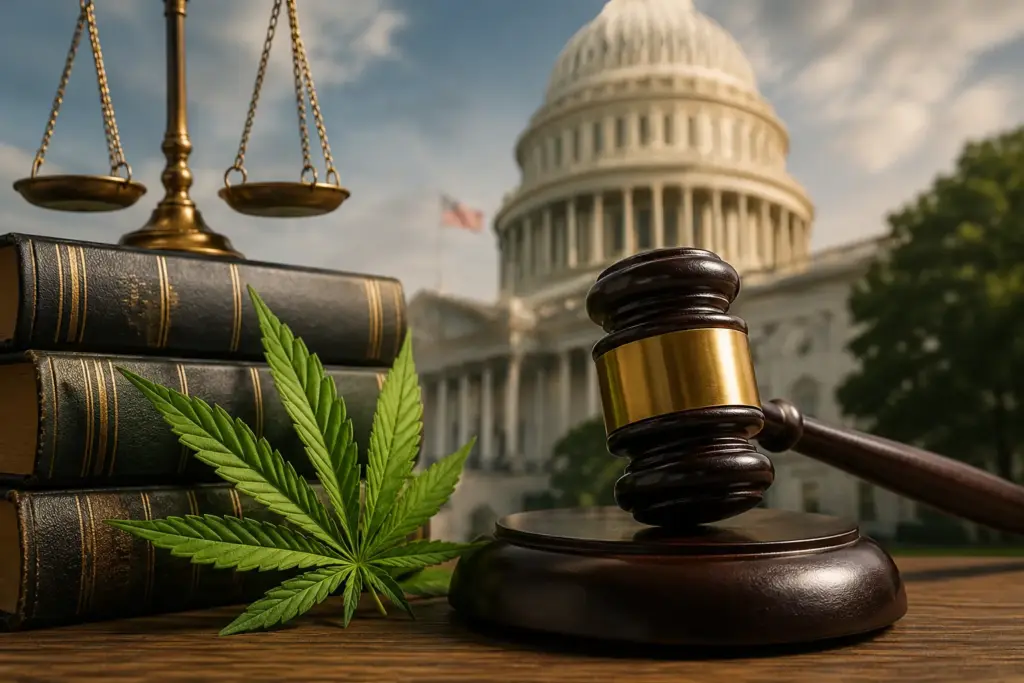
For more than fifty years, cannabis law in the United States has been shaped by a decision many people misunderstand.
I often hear people say, “Wasn’t marijuana placed in Schedule One for a reason?” The assumption is that Congress had clear scientific evidence that cannabis belonged in the most restrictive category of controlled substances.
The actual history is more complicated.
When Congress created the federal Controlled Substances Act, marijuana was placed in Schedule One while the government waited for more study. That study came from the National Commission on Marihuana and Drug Abuse, commonly known as the Shafer Commission. The commission was led by former Pennsylvania Governor Raymond Shafer.
After reviewing the issue, the Shafer Commission did not recommend continued harsh criminal treatment for simple marijuana possession. It recommended a more measured approach, including decriminalization for personal use.
That recommendation was not adopted.
Marijuana remained in Schedule One for decades. During that time, countless people faced criminal charges, probation, fines, jail exposure, employment problems, and permanent records connected to cannabis.
That history still matters. Even as marijuana laws continue to change, cannabis related charges can still carry serious consequences in Pennsylvania and federal court.
What Does Schedule One Mean?
Under the federal Controlled Substances Act, controlled substances are divided into schedules. Schedule One is the most restrictive category.
A Schedule One classification has traditionally meant that the federal government considers a substance to have:
- A high potential for abuse
- No accepted medical use under federal law
- A lack of accepted safety for use under medical supervision
For decades, marijuana was treated under federal law in the same broad category as some of the most serious controlled substances. That classification affected more than criminal prosecutions. It influenced medical research, public opinion, sentencing policy, probation rules, employment decisions, firearm rights, and the way marijuana cases were viewed in court.
As a criminal defense attorney, I have seen how labels matter. Once a substance is placed in the most restrictive legal category, that label can affect how police investigate cases, how prosecutors file charges, and how the public views the person accused.
That is why the history matters. Cannabis Schedule One status was not the result of a final scientific finding that ended the debate. It began as a temporary classification while the federal government waited for more information.
Why Is Cannabis Schedule One?
Cannabis was placed in Schedule One when the federal government created the modern drug scheduling system. At the time, lawmakers had not fully resolved how marijuana should be treated.
Instead of making a final decision based on a complete record, the government placed marijuana in Schedule One while it waited for the Shafer Commission to study the issue.
The commission’s findings did not support the idea that simple marijuana possession should be treated with the full force of harsh criminal punishment. The commission recommended decriminalization for personal use and urged a more rational approach to marijuana policy.
That recommendation was rejected by the Nixon administration.
As a result, marijuana remained in Schedule One for generations. The consequences were not theoretical. People were arrested, prosecuted, placed on probation, denied opportunities, and left with criminal records because of cannabis related allegations.
Why the Shafer Commission Still Matters
The Shafer Commission matters because it challenges the idea that marijuana’s Schedule One status was based on a settled scientific consensus.
The commission’s work showed that cannabis policy was influenced by politics, public fear, cultural attitudes, and law enforcement priorities. Those forces helped shape a legal classification that affected millions of people.
In criminal defense, assumptions matter. A controlled substance label can influence how a case is perceived before anyone looks closely at the facts. People may assume the charge is more serious, the accused person is more dangerous, or the government’s case is stronger than it really is.
Those assumptions are not proof.
Every criminal case must stand on its own facts. The government has the burden of proof. Police must follow constitutional rules. Prosecutors must prove the required legal elements. A person accused of a marijuana offense still has rights.
Cannabis Law Has Changed, Yet Legal Risk Remains
Cannabis law has changed significantly across the country. Many states now allow medical marijuana. Some states have legalized adult recreational use. Pennsylvania has a medical marijuana program for qualifying patients who follow the rules.
That does not mean marijuana is risk free.
In Pennsylvania, cannabis related issues can still lead to criminal charges or other legal problems, including:
- Possession without proper authorization
- Marijuana found during a traffic stop
- Driving under the influence allegations involving cannabis
- Possession with intent to deliver accusations
- Probation or parole violations
- Firearm related cases
- Federal investigations
- Search and seizure disputes
- School, employment, or professional licensing consequences
This is where many people get into trouble. They assume that because marijuana laws have changed, a marijuana charge is no longer serious.
That assumption can be dangerous.
Even a misdemeanor can affect a person’s record, reputation, job, education, and future. More serious cannabis related cases may involve felony charges, allegations of distribution, firearm issues, or federal prosecution.
The specific facts matter. The location of the arrest matters. The person’s record matters. The court matters. The evidence matters.
Medical Marijuana Does Not Prevent Every Criminal Charge
Pennsylvania’s medical marijuana program provides lawful access for qualifying patients. A valid medical marijuana card can be important, but it does not protect a person from every possible legal problem.
Medical marijuana patients may still face issues involving:
- Driving under the influence allegations
- Possession outside the rules of the medical marijuana program
- Use or possession in prohibited places
- Firearm related restrictions
- Probation conditions
- Employment policies
- Conflicts with federal law
Driving under the influence cases involving cannabis are especially complicated.
In an alcohol case, blood alcohol concentration often plays a central role. Marijuana cases can be different. The presence of cannabis in a person’s system does not always answer the most important question: was the person actually impaired at the time of driving?
A careful defense may involve reviewing:
- The reason for the traffic stop
- The officer’s observations
- Field sobriety testing
- Statements made during the investigation
- Blood testing
- Laboratory procedures
- Medical marijuana authorization
- Whether the evidence proves impairment
These cases should not be treated as routine. The difference between lawful medical use and a criminal conviction can depend on details that require close legal review.
Drug Charges Are About More Than the Substance
In marijuana and drug cases, the legal issues often go far beyond the substance itself.
One of the first questions I look at is whether the police acted lawfully. Officers must follow constitutional rules when they stop a person, search a vehicle, enter a home, seize property, or question a suspect. If law enforcement violated those rules, the defense may be able to challenge the evidence.
Another key question is possession. Prosecutors must prove that the accused person knowingly possessed the substance. That can become complicated when the case involves a shared vehicle, shared home, hotel room, borrowed bag, or multiple people.
Intent is also important. Possession for personal use is different from possession with intent to deliver. Prosecutors may point to packaging, money, messages, scales, statements, or other evidence to argue that a person intended to distribute marijuana. A defense attorney must examine whether the evidence actually supports that accusation.
A person’s background can also affect the case. Prior convictions, probation status, parole status, pending charges, or eligibility for diversionary programs may influence the defense strategy.
No two cases are exactly alike. A strong defense begins with the facts.
Why Experience Matters in Marijuana and Drug Defense Cases
I have spent more than twenty four years in criminal law as both a prosecutor and criminal defense attorney. That background matters in drug cases.
As a former prosecutor, I understand how the government evaluates evidence, builds cases, and makes charging decisions. As a defense attorney, I understand how to challenge weak evidence, unlawful searches, overcharged allegations, and unfair assumptions.
A defense strategy may include:
- Challenging the legality of the stop
- Challenging the search or seizure
- Reviewing laboratory evidence
- Examining whether the accused person knowingly possessed the substance
- Disputing possession with intent to deliver allegations
- Negotiating for reduced charges or alternative outcomes
- Preparing for trial when necessary
- Protecting the client’s record, license, job, and future
The goal is not only to respond to the charge. The goal is to understand what is at stake and build a defense that fits the client, the evidence, and the courtroom.
The Human Side of Cannabis Charges
A marijuana charge can be frightening, embarrassing, and frustrating. Many people charged with cannabis related offenses do not see themselves as criminals. They may be medical marijuana patients, working professionals, parents, students, or people who have never been in serious trouble before.
The stress can be immediate. A person may worry about:
- Jail
- Probation
- A permanent criminal record
- Losing a job
- Losing a professional license
- School discipline
- Family consequences
- Immigration concerns
- Firearm rights
- Court costs and fines
Those concerns are real. A criminal case is not just a legal problem. It can affect nearly every part of a person’s life. Clients deserve to be treated with respect, not judgment. They deserve clear explanations, honest advice, and a defense focused on protecting their future.
At PKN Law, I approach every case with preparation, attention to detail, and a commitment to holding the government to its burden.
Why This History Should Matter to Defendants Today
The history of cannabis scheduling is not just a policy debate. It helps explain why marijuana law remains so complicated.
A temporary federal classification became a long lasting legal reality. That classification influenced decades of arrests, prosecutions, and criminal records. Even now, as public opinion and state laws continue to change, cannabis related charges can still create serious problems.
For defendants, this history is a reminder that the name of the charge does not tell the whole story.
The government still has to prove its case. Police still have to follow the Constitution. Evidence can still be challenged. Charges can still be negotiated, reduced, dismissed, or fought at trial depending on the facts.
A marijuana charge should never be ignored. It should also never be treated as hopeless.
What Should You Do If You Are Facing a Marijuana Charge in Pennsylvania?
If you are facing a marijuana charge, drug charge, or driving under the influence allegation involving cannabis, take the situation seriously from the beginning.
Important steps include:
- Do not assume the charge will go away on its own
- Do not discuss the facts of the case with police without legal guidance
- Keep all paperwork from law enforcement and the court
- Write down what happened while the details are fresh
- Identify possible witnesses
- Preserve any medical marijuana documentation
- Speak with an experienced criminal defense attorney
Early legal advice can make a meaningful difference. Important defense issues may need to be raised quickly. Missed court dates, unnecessary statements, or delays in reviewing the evidence can make the case harder to defend.
Frequently Asked Questions
Why was cannabis placed in Schedule One?
Cannabis was placed in Schedule One during the creation of the federal Controlled Substances Act while the government waited for further study. That study came from the Shafer Commission, which later recommended decriminalization for personal use rather than continued harsh criminal treatment.
Did the Shafer Commission recommend keeping marijuana in Schedule One?
No. The Shafer Commission did not recommend keeping marijuana under harsh criminal treatment for simple possession. The commission supported a more measured approach and recommended decriminalization for personal use.
Is marijuana legal in Pennsylvania?
Pennsylvania has a medical marijuana program for qualifying patients who follow the rules. Recreational marijuana is not fully legal statewide. Marijuana related conduct can still lead to criminal charges depending on the facts.
Can a medical marijuana patient still be charged with driving under the influence?
Yes. A valid medical marijuana card does not prevent a driving under the influence charge. If law enforcement claims a person was impaired or violated Pennsylvania law, that person may still face criminal charges.
Can marijuana charges affect my record?
Yes. Marijuana charges can affect a criminal record, employment, education, professional licensing, probation status, and future opportunities. The impact depends on the charge, the facts, the person’s record, and the outcome of the case.
Can police search my car because they smell marijuana?
Search and seizure law involving marijuana can be complicated, especially because Pennsylvania has a medical marijuana program. Whether a search was lawful depends on the facts. A defense attorney can review the stop, search, and seizure to determine whether the evidence may be challenged.
What should I do if I am charged with a marijuana offense?
Take the charge seriously, avoid discussing the facts with law enforcement without legal guidance, keep all paperwork, and speak with an experienced criminal defense attorney as soon as possible.
Speak With a Pennsylvania Marijuana Defense Attorney
Cannabis law has changed, but marijuana related charges can still carry serious consequences. Whether the case involves possession, driving under the influence, possession with intent to deliver, probation issues, firearms, or federal court, the details matter.
I defend clients in Pennsylvania state and federal criminal cases. With more than twenty four years of experience as both a former prosecutor and criminal defense attorney, I understand how to challenge the government’s case and protect my clients’ rights.
To schedule a consultation with PKN Law, call (412) 454-5582 or visit patricknightingale.com.