When Congress passed the 2018 Farm Bill, it fundamentally changed how hemp was treated under federal law. What many people did not fully appreciate at the time was how much legal significance Congress placed on a single chemical measurement.
That measurement was a delta-9 tetrahydrocannabinol concentration of no more than 0.3 percent on a dry-weight basis.
I want to focus on that definition because it helps explain many of the legal questions surrounding smokable hemp, THCA flower, and other cannabis-derived products. It also demonstrates why the precise language of a statute matters when someone is accused of violating the law.
I have spent more than 24 years working as both a prosecutor and a criminal defense attorney. My experience has taught me that an important part of evaluating a criminal prosecution is determining exactly what the government must prove. That includes understanding the law as it was written, not simply how someone believes it should apply.
Hemp and marijuana provide a particularly useful example. These products can look nearly identical, yet their legal classification may depend on chemical testing, statutory definitions, and the date of the alleged conduct.
For someone facing a criminal investigation, those distinctions are not merely academic. They may affect whether the substance involved meets the legal definition of a controlled substance and whether the government can establish the charges.
What Did Congress Legalize Under the 2018 Farm Bill?
On December 20, 2018, President Donald Trump signed the Agriculture Improvement Act of 2018, commonly known as the Farm Bill.
Among its many provisions, the legislation established a federal framework for hemp production and removed qualifying hemp from the federal Controlled Substances Act definition of marijuana.
Congress defined hemp as Cannabis sativa L. and its parts, including derivatives and cannabinoids, provided the material contained no more than 0.3 percent delta-9 tetrahydrocannabinol on a dry-weight basis.
That definition can be found in Title 7, Section 1639o of the United States Code.
Before this legislation, federal controlled-substance law generally classified cannabis plants as marijuana unless a specific exclusion applied. The Farm Bill created an important distinction between marijuana and hemp based on chemical composition.
Congress also addressed the interstate transportation of hemp lawfully produced under the applicable regulatory framework.
What Congress did not do was legalize all forms of cannabis or eliminate every restriction on products containing cannabinoids.
This is an important point. The Farm Bill changed the federal legal classification of qualifying hemp. It did not create unrestricted permission to manufacture, distribute, possess, or sell every cannabis-derived product.
Federal agricultural regulations, state controlled-substance laws, and other requirements continued to apply.
From a criminal defense perspective, the significant development was that federal law now expressly distinguished certain cannabis material from marijuana based on its delta-9 THC concentration.
Why the Definition of Hemp Matters More Than Many People Realize
When I examine a criminal statute, I pay close attention to the language Congress or the Pennsylvania General Assembly chose to use.
The words matter. So do the limitations and exceptions.
In the case of the 2018 Farm Bill, Congress established a concentration threshold specifically for delta-9 THC.
It did not expressly define hemp using a comprehensive total THC threshold that included every potentially relevant cannabinoid.
That distinction contributed to substantial legal controversy.
Cannabis plants contain numerous chemical compounds known as cannabinoids. Some have intoxicating effects, while others do not produce the same effects.
One of those compounds is tetrahydrocannabinolic acid, commonly called THCA.
THCA naturally occurs in cannabis. When heated, including through smoking or vaporization, it can convert into delta-9 THC through a chemical process known as decarboxylation.
This relationship became particularly important as products containing substantial amounts of THCA appeared in retail markets.
Some smokable cannabis flower was marketed as hemp because its measured delta-9 THC concentration fell within the original federal threshold.
The difficulty is that the same flower might contain significant amounts of THCA.
The legal question became whether a product satisfying the original delta-9 THC concentration standard nevertheless violated other applicable laws or regulations.
That question cannot be resolved by looking only at the product’s appearance or marketing description.
It requires an examination of the relevant statute, the chemical composition of the material, and the circumstances surrounding its production, possession, or distribution.
I have addressed related issues in my discussion of whether THCA is legal in Pennsylvania.
The point I want to emphasize here is that a statutory definition can have consequences far beyond what legislators may have anticipated when they originally adopted it.
Does the Farm Bill Make Smokable Hemp Legal?
The short answer is that qualifying hemp was removed from the federal definition of marijuana, but that does not mean every smokable cannabis product is automatically lawful.
There are several reasons.
First, the original Farm Bill established a particular federal definition of hemp. It did not override every state law governing cannabis products.
Second, the legality of a particular product may depend on whether it was produced, tested, transported, and distributed in compliance with applicable requirements.
Third, federal law continues to distinguish between agricultural hemp production and other aspects of cannabis regulation.
Pennsylvania also maintains its own controlled-substance laws and hemp production requirements.
The Pennsylvania Department of Agriculture’s hemp program guidance describes the Commonwealth’s regulatory framework for hemp cultivation and processing, including testing requirements.
Agricultural compliance requirements are important, but they should not be confused with an automatic determination that every retail cannabis product is lawful.
A product can be advertised as hemp while still raising questions under Pennsylvania law.
This is especially relevant because Pennsylvania has a regulated medical marijuana program but has not generally legalized recreational marijuana.
I have discussed that distinction separately in my article on marijuana possession laws in Pennsylvania.
Consumers should understand that purchasing a cannabis product from a retail establishment does not necessarily establish that possession or distribution is lawful under every applicable statute.
Why Laboratory Testing Can Become Central to a Criminal Case
One of the most important questions in a cannabis prosecution is whether the government can establish the identity and legal classification of the substance.
Consider a situation in which police discover several packages of smokable cannabis flower during a vehicle search.
The packaging identifies the product as hemp. There may even be a laboratory certificate indicating that the product falls below a specified delta-9 THC concentration.
Police nevertheless suspect that the material is marijuana.
How should that evidence be evaluated?
The answer depends on the circumstances, including the law applicable to the alleged offense.
A product label does not necessarily establish what the substance contains. At the same time, an officer’s belief that the material is marijuana does not necessarily establish its precise chemical composition.
A laboratory examination may become important.
What Does the Laboratory Report Actually Establish?
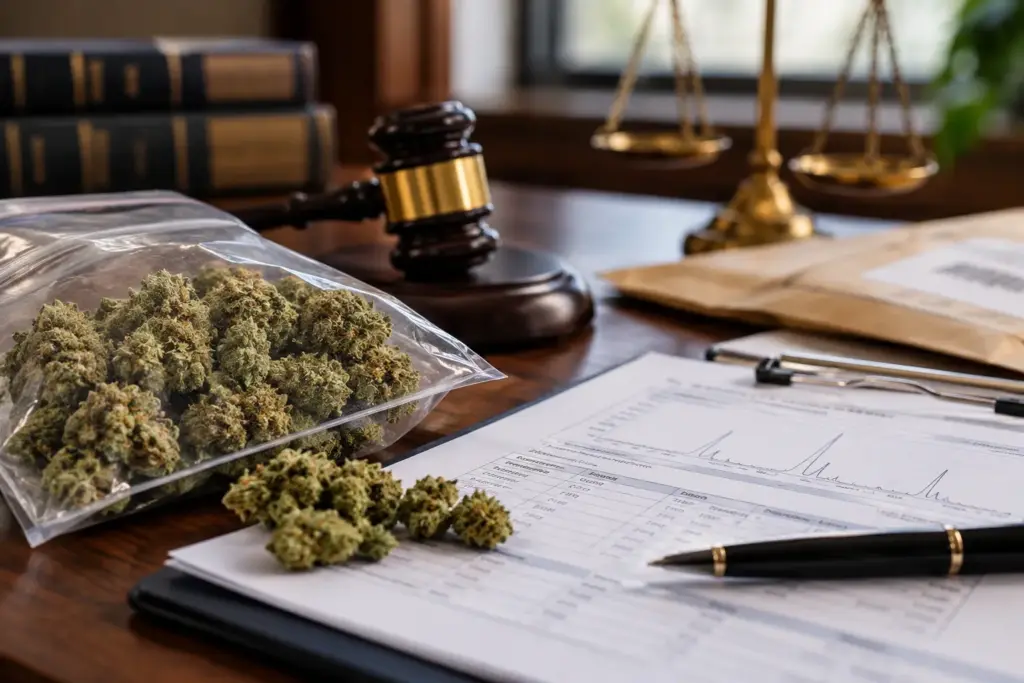
A laboratory report may identify delta-9 THC, THCA, and other cannabinoids.
It may report their individual concentrations or calculate a total THC value using a specified formula.
Those results must be interpreted in light of the legal standard that applies.
If the prosecution depends on establishing that a substance meets a particular statutory definition, I want to understand whether the testing actually addresses that definition.
The relevant questions may include which compounds were measured, which analytical methods were used, and whether the findings establish the elements of the charged offense.
I also want to examine whether the tested sample is adequately connected to the material police seized.
A laboratory certificate supplied by a retailer may have evidentiary value, but it does not necessarily establish the composition of every product sold under the same brand.
Likewise, a government laboratory report should be evaluated for what it proves and what it does not prove.
Scientific evidence deserves careful review rather than automatic acceptance.
Why the Chain of Custody Matters
When police seize a suspected controlled substance, the handling and identification of that evidence can become important.
A chain of custody documents how evidence is collected, transferred, stored, and submitted for testing.
An attorney reviewing a prosecution may examine whether the evidence was properly identified and whether any irregularities affect the reliability or admissibility of the laboratory findings.
Not every imperfection in an evidence record will justify excluding the material. The legal significance depends on the circumstances.
However, the government must still establish the elements of the offense through admissible evidence.
That obligation does not disappear merely because the substance looks or smells like marijuana.
Federal Hemp Law Is Changing Again in 2026
The questions generated by the original Farm Bill eventually led Congress to revisit the federal definition of hemp.
In November 2025, Congress enacted legislation substantially revising that definition.
The changes include a total tetrahydrocannabinol concentration standard that expressly accounts for THCA. The legislation also excludes certain cannabinoid products from the federal hemp definition and creates separate limits for specified finished hemp-derived products.
These changes are significant because the original Farm Bill measured delta-9 THC, while the revised definition considers total THC.
The distinction could affect products previously marketed as compliant hemp.
Congress subsequently delayed the effective date of most of these amendments.
As of October 30, 2026, the revised schedule provides that certain exclusions involving cannabinoids that cannot naturally be produced by the cannabis plant will take effect on November 12, 2026. Most remaining changes are scheduled to take effect on December 11, 2026.
The Congressional Research Service’s September 2026 analysis explains the amended definition and the legislative developments affecting implementation.
Its October 28, 2026 legal analysis addresses the delayed changes and the treatment of certain cannabinoids.
The important point is that hemp law is continuing to evolve.
I would caution against treating the legal status of a particular product in 2019, 2023, or even early 2026 as necessarily identical to its status after these amendments become effective.
The law applicable to a particular case must be determined based on the alleged conduct and the governing provisions.
Why the Date of the Alleged Offense Is Important
When a criminal statute changes, the date of the alleged conduct can become significant.
This principle is particularly important in cases involving products whose legal classification has changed over time.
Suppose someone is accused of distributing a hemp-derived product before an amendment becomes effective. The government cannot simply assume that a subsequently adopted definition governed the earlier conduct.
The applicable law, effective date, and constitutional protections concerning retroactive criminal punishment must be examined.
That does not mean a legislative change automatically invalidates existing prosecutions.
It means the analysis must begin with the correct legal framework.
In my practice, I want to know what conduct the government alleges, when that conduct occurred, which statute applies, and what evidence supports the prosecution.
Those questions are fundamental to criminal defense, regardless of whether the accusation involves cannabis, another controlled substance, or a different criminal offense.
What I Look for When Defending a Cannabis-Related Criminal Case
Having worked as both a prosecutor and a defense attorney, I understand the importance of evaluating the government’s evidence from multiple perspectives.
A defense cannot rest solely on whether the accused believes a product was lawful.
I need to examine the facts, understand the applicable law, and determine what prosecutors can establish.
In a hemp or marijuana case, that analysis may involve several distinct issues.
Was the Search Lawful?
The Fourth Amendment protects individuals against unreasonable searches and seizures.
When police discover cannabis during a traffic stop, vehicle search, or search of a residence, I examine the circumstances under which officers obtained the evidence.
Was the initial stop justified? Did officers have lawful grounds to conduct the search? Was a warrant required? Did a recognized exception apply?
These are fact-specific questions.
The legality of the search is separate from the chemical composition of the seized material. Even when a laboratory identifies a controlled substance, the manner in which police obtained it may remain legally significant.
Can the Government Prove Possession?
The presence of a controlled substance in a vehicle or residence does not automatically establish that every person nearby possessed it.
Pennsylvania law recognizes different forms of possession, including actual and constructive possession.
Constructive possession generally requires proof related to a person’s ability and intent to exercise control over the substance.
A person’s mere proximity to an item may not be sufficient.
In cases involving shared vehicles, residences, or property, the evidence concerning knowledge, access, and control can become particularly important.
What Evidence Supports an Allegation of Distribution?
Possession with intent to deliver is a more serious allegation than simple possession.
Prosecutors may rely on the quantity of a substance, packaging, communications, money, or other circumstances when attempting to establish intent.
I examine whether the evidence actually supports the conclusions the prosecution is asking a court or jury to draw.
A substance’s classification is important, but it is not the only element prosecutors must establish.
I discuss these and other defense considerations in greater detail through my Pittsburgh drug crimes defense practice.
Why Buying a Product in a Store Does Not Necessarily Make It Legal
One of the misconceptions surrounding hemp-derived products is that retail availability necessarily establishes legality.
I understand why consumers might reach that conclusion.
When someone sees a cannabis product displayed openly in a convenience store, smoke shop, or other retail establishment, it is reasonable for that person to wonder why the product would be offered for sale if possession were unlawful.
However, the existence of a retail market does not eliminate criminal or regulatory restrictions.
A manufacturer may describe a product as Farm Bill compliant. A retailer may believe that description is accurate. A consumer may purchase the product without understanding the differences between federal and state law.
Those circumstances do not necessarily resolve the product’s legal classification.
They may be relevant to particular issues in a criminal case, including what a person knew or believed, depending on the offense and applicable law.
I would not assume that every individual who purchases a product marketed as hemp has knowingly violated the law. I also would not advise anyone to rely exclusively on a product label as proof of legality.
The appropriate analysis requires more than either assumption.
What Should You Do if You Are Charged With Possessing or Distributing Hemp?
If you are facing a criminal investigation involving hemp, THCA, or another cannabis-derived product, preserving relevant information may be important.
Purchase receipts, original packaging, product descriptions, laboratory certificates, and transaction records may help an attorney understand the circumstances.
That information should not be altered, concealed, or destroyed.
I also recommend obtaining legal advice before attempting to explain the allegations to investigators.
People sometimes believe they can resolve a misunderstanding by telling police that they purchased the material legally or that the product was advertised as hemp.
Those explanations do not necessarily resolve the legal issues, and statements made during an investigation may later become evidence.
An attorney can assess whether speaking with investigators is appropriate and help protect the client’s constitutional rights.
Every criminal case is different. I cannot determine whether a particular defense applies without examining the facts and evidence.
What I can say is that criminal accusations involving cannabis deserve the same careful legal analysis as any other prosecution.
The Government Must Prove Its Case Under the Law
The 2018 Farm Bill is an example of how a relatively small distinction in statutory language can create significant legal consequences.
By defining hemp through a specific delta-9 THC concentration, Congress changed the federal treatment of qualifying cannabis products.
The omission of an express total THC standard from the original definition contributed to legal uncertainty surrounding smokable hemp and THCA products.
Congress has since enacted revisions intended to address aspects of that regulatory framework.
From my perspective as a criminal defense attorney, the most important principle remains unchanged: the government must establish the elements of a criminal offense under the applicable law.
It is not enough to assume that a substance is illegal because it looks like marijuana. It is not enough to rely on a product’s marketing description to establish that it is lawful.
The statute, scientific evidence, facts, and constitutional protections all matter.
Throughout my career, both as a prosecutor and as a defense attorney, I have believed that the integrity of the criminal justice system depends on holding the government to its burden of proof.
That is the approach I bring to the defense of people accused of drug offenses in Pennsylvania and federal courts.
If you are facing criminal charges involving marijuana, hemp, THCA, or another controlled substance, I invite you to contact my office to schedule a confidential consultation.
I can review the circumstances of your case, explain the applicable legal issues, and discuss the options available to you.
Patrick K. Nightingale, Esquire
PKN Law | Pittsburgh Criminal Defense Attorney
Phone: (412) 454-5582
This article is provided for general educational purposes and reflects federal hemp developments as of October 30, 2026. It is not a substitute for individualized legal advice.
Frequently Asked Questions
Is smokable hemp legal in Pennsylvania?
The answer depends on the product’s composition and the applicable laws. Federal hemp classification does not automatically establish that every smokable cannabis product may lawfully be possessed or sold in Pennsylvania.
Did the 2018 Farm Bill legalize marijuana?
No. The legislation removed qualifying hemp from the federal definition of marijuana. It did not broadly legalize recreational marijuana or eliminate all restrictions on cannabis products.
Why is the 0.3 percent THC threshold important?
The original federal definition of hemp used a delta-9 THC concentration limit of 0.3 percent on a dry-weight basis. Whether cannabis material satisfied that definition could affect its classification under federal controlled-substance law.
What is the difference between THCA and delta-9 THC?
THCA is a cannabinoid naturally found in cannabis. When heated, it can convert into delta-9 THC, the principal psychoactive cannabinoid associated with marijuana. The distinction matters because different legal standards may measure these compounds differently.
Are federal hemp laws changing in 2026?
Yes. Congress enacted changes to the federal definition of hemp. As of October 30, 2026, certain provisions are scheduled to take effect November 12, while most remaining changes are scheduled for December 11, 2026.
Can police distinguish hemp from marijuana by looking at it?
Appearance alone generally cannot establish a cannabis product’s precise cannabinoid concentrations. Laboratory testing may be necessary to determine whether the material satisfies an applicable legal definition.
What should someone do if charged with possessing smokable hemp?
They should consider consulting a criminal defense attorney who can examine the product’s classification, laboratory evidence, police conduct, and applicable statutes. Relevant product and purchase records should be preserved.