A criminal conviction can continue to affect a person long after probation, parole, fines, and other parts of a sentence have ended. One of the most significant collateral consequences is the loss of the legal right to possess a firearm.
For decades, federal law contained a mechanism allowing certain prohibited individuals to apply for restoration of federal firearm rights, but the program was largely unavailable in practice. That changed in 2026.
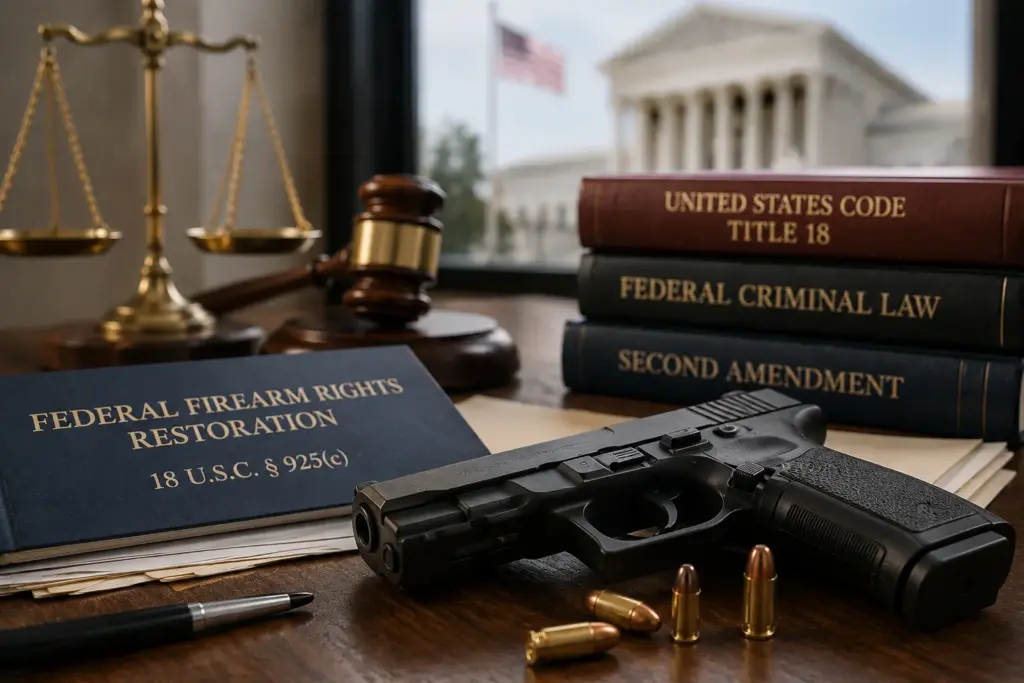
On August 17, 2026, the United States Department of Justice announced a new Federal Firearm Rights Restoration program under Title 18 of the United States Code, Section 925(c). The program creates an administrative process through which certain people prohibited under federal law may ask the Attorney General to restore their federal firearm rights.
That does not mean every old conviction can be erased, that every applicant will qualify, or that federal approval automatically restores firearm rights under Pennsylvania law. The process requires a careful examination of the original prohibition, the applicant’s record and conduct, the facts surrounding prior offenses, and any state-law restrictions that continue to apply.
For Pennsylvania residents with an old conviction, understanding the difference between federal and state firearm restrictions is especially important before taking any action involving a firearm.
What Is Federal Firearm Rights Restoration?
Federal law prohibits certain categories of people from possessing, receiving, shipping, or transporting firearms or ammunition. These prohibitions appear primarily in Title 18 of the United States Code, Section 922(g).
Section 925(c) provides a separate avenue for relief. It permits a federally prohibited person to apply to the Attorney General for restoration of firearm rights. Under the statute, relief may be granted when the applicant’s circumstances, record, and reputation demonstrate that the person is not likely to act in a manner dangerous to public safety and that restoring the rights would not be contrary to the public interest. Title 18 of the United States Code, Section 925(c)
The current process is administered through the Office of the Pardon Attorney rather than the Bureau of Alcohol, Tobacco, Firearms and Explosives. The Department of Justice describes the program as an individualized review rather than an automatic restoration mechanism. Federal Firearm Rights Restoration program
This distinction matters. The existence of an application process does not mean an applicant is entitled to relief simply because a conviction is old.
When Does the New Federal Application Process Open?
As of September 3, 2026, the general public application process has not fully opened.
The Department of Justice has announced a staged rollout:
September 25, 2026: The application process is scheduled to open to invited candidates.
November 4, 2026: The process is scheduled to open to the first 5,000 members of the public who apply.
January 4, 2027: An additional public phase is scheduled to begin, with 500 additional applicants permitted during that rollout stage. The application fee is also scheduled to begin at that time.
Because the program is new and implementation details may continue to change, people considering an application should review the current Department of Justice instructions before beginning the process.
The Department has also warned applicants that once an electronic application is initiated, the applicant generally has 30 days to complete it. Gathering records before beginning may therefore be important.
Who May Apply for Federal Firearm Rights Restoration?
The Department of Justice states that an individual who is currently prohibited under one or more categories in Section 922(g) may apply for restoration.
Those categories include people prohibited because of certain felony convictions, fugitive status, unlawful controlled-substance use, certain mental-health adjudications or commitments, certain immigration statuses, dishonorable military discharge, renunciation of United States citizenship, qualifying domestic violence restraining orders, and misdemeanor crimes of domestic violence. Department of Justice eligibility guidance for federal firearm rights restoration
Being permitted to submit an application is different from being likely to receive relief.
Some people will face what the Department calls a “presumptive disqualifier.” In those circumstances, relief may be denied unless the applicant can demonstrate extraordinary circumstances sufficient to overcome the presumption.
That makes the legal and factual history of the case particularly important.
Why the Age of a Conviction Matters, but Does Not Decide the Case
A conviction from twenty or thirty years ago may look very different today than it did when the sentence was imposed.
A person may have completed every requirement of the sentence, maintained steady employment, raised a family, avoided further criminal activity, participated in community organizations, and otherwise established a long record of lawful conduct.
Those facts can be relevant because Section 925(c) directs the government to consider the applicant’s record and reputation as part of the assessment.
Still, time alone does not guarantee restoration.
The Department’s current rule identifies categories of convictions and conduct that may create permanent, ten-year, five-year, current-status, or reapplication presumptions against relief. In some cases, the government may look beyond the formal title of the conviction and examine the conduct underlying the offense. Federal firearm rights restoration presumptive disqualifiers
For that reason, two people who appear to have similar criminal records may face very different restoration analyses.
What Types of Offenses Can Make Federal Relief More Difficult?
The final rule identifies certain categories that may create a strong presumption against restoration.
Examples include convictions involving death, sexual assault, human trafficking, kidnapping, domestic violence, robbery, burglary, extortion, carjacking, arson, certain violent racketeering conduct, assault, stalking, terrorism, witness tampering, and related attempts or conspiracies.
The rule also addresses situations in which a firearm or explosive was used during a qualifying crime.
These provisions should not be interpreted as a simple checklist. The Department states that it may consider conduct similar to the listed offenses and may examine the underlying facts rather than relying solely on the offense name.
A person considering an application should therefore understand exactly what appears in the charging documents, judgment, plea agreement, sentencing materials, and related records.
PKN Law regularly handles cases involving both Pennsylvania and federal firearm laws. More information about the firm’s work in this area is available through its gun crimes and firearms defense practice.
What Documents May Be Required?
The new process is document intensive.
According to the Department of Justice, applicants may need criminal-history reports covering the last 25 years or the period since they turned eighteen, whichever is shorter. Depending on the reason for the federal firearm prohibition, additional records may be required. Department of Justice list of required restoration documents
For a person prohibited because of a felony conviction, relevant documents may include:
The charging document, such as the criminal complaint or indictment.
The judgment of conviction.
Proof showing when all requirements of the sentence were completed.
A plea agreement, if applicable.
The factual basis supporting a plea.
A presentence report or other sentencing document, when applicable.
The Department has established separate document requirements for applicants whose restrictions arise from other circumstances, including misdemeanor domestic violence convictions, certain mental-health matters, military convictions, or renunciation of citizenship.
Older cases can create practical difficulties because records may be stored in archives, maintained by several agencies, or unavailable through ordinary electronic court systems.
The final rule provides procedures for addressing certain unavailable records, including sworn statements describing the missing record and efforts made to obtain it. That does not mean missing documentation can simply be ignored.
Character References Are Part of the Process
The Department of Justice currently requires three character references.
A reference cannot be related to the applicant by blood or marriage, must generally have known the applicant for at least three years, and cannot currently be prohibited from possessing a firearm under federal law. Department of Justice character reference requirements
References may be contacted and asked to provide information concerning the applicant.
This requirement reflects the broader purpose of Section 925(c). The government is not merely reviewing whether a conviction exists. It is evaluating whether the applicant’s present circumstances, history, and reputation support a finding that restoring federal firearm rights would be consistent with public safety and the public interest.
Federal Restoration Does Not Automatically Restore Pennsylvania Firearm Rights
This is one of the most important parts of the process for Pennsylvania residents.
A successful federal application restores federal firearm rights within the scope of the federal determination. The Department of Justice expressly states that its program cannot remove an independent firearm prohibition imposed by state law.
Pennsylvania has its own firearm restrictions under Section 6105 of the Pennsylvania Crimes Code. That statute prohibits firearm possession for people with certain convictions and for people who meet other statutory criteria. Pennsylvania also has specific procedures through which some individuals may seek relief depending on the source of the restriction. Pennsylvania’s statutory firearm possession restrictions
A person can therefore face two separate questions:
Is the person prohibited under federal law?
Is the person separately prohibited under Pennsylvania law?
The answers are not necessarily identical.
A federal grant should never be assumed to authorize possession in Pennsylvania without first determining whether Pennsylvania law imposes an independent disability.
Likewise, relief granted under Pennsylvania law does not always resolve every possible federal restriction.
This overlap is one reason firearm-rights cases require close examination of both systems rather than reliance on a single court order, pardon, or agency determination.
How Pennsylvania Pardons May Fit Into the Analysis
For some Pennsylvania convictions, a gubernatorial pardon may provide another potential path toward addressing the continuing consequences of a criminal record.
The Pennsylvania Board of Pardons states that a pardon can restore rights and privileges lost because of an offense, including the ability in qualifying circumstances to own and carry a lawfully obtained firearm. The effect of a pardon depends on the particular conviction and the applicable state and federal laws. Pennsylvania Board of Pardons clemency information
Pennsylvania law also contains specific firearm-restoration provisions that apply in particular circumstances. Section 6105.1, for example, provides a court process for certain disabling offenses arising under prior Pennsylvania laws. It is not a general restoration mechanism for every person prohibited from possessing a firearm.
Someone with a Pennsylvania conviction may therefore need to consider whether the appropriate route involves federal restoration, state-court relief, a pardon, or some combination of remedies.
PKN Law represents individuals in post-conviction and pardon matters, and additional information is available through the firm’s appeals, post-conviction, and pardons practice page.
What Happens If the Department of Justice Grants the Application?
If federal firearm rights are restored, the Department states that the Federal Bureau of Investigation will update the National Instant Criminal Background Check System.
An applicant may also receive a unique restoration identification number that can be used when attempting to purchase a firearm.
The person’s name and date of the grant will be published in the Federal Register because Section 925(c) requires public notice when relief is granted.
Again, the federal grant does not eliminate a separate Pennsylvania prohibition.
A person should confirm the legal effect of the federal decision and any remaining state restrictions before attempting to purchase, possess, carry, transport, or otherwise handle a firearm.
What Happens If an Application Is Denied?
A denial is not necessarily the end of every possible legal avenue.
Section 925(c) permits an applicant whose request is denied to seek judicial review in the United States District Court for the district where the person resides. The statute permits the court, in certain circumstances, to admit additional evidence when failing to do so would result in a miscarriage of justice.
The Department also states that some applicants may be able to apply again after an applicable waiting period.
There is a significant difference between a denial, an indeterminate result, and an administrative closure without action. Each may have different implications for what happens next.
Anyone evaluating a denial should review the actual decision and the reasons given rather than assuming another application is immediately available.
For matters involving federal criminal law and federal court procedure, PKN Law’s federal criminal defense practice provides additional information about the firm’s federal practice.
Why You Should Determine the Source of the Prohibition Before Applying
One of the easiest mistakes to make is assuming that a prior conviction is the only reason a person cannot lawfully possess a firearm.
A criminal record may contain multiple convictions. A person may also be subject to a state-law restriction that differs from the federal prohibition. Records may be incomplete or contain an error. A prior pardon, expungement, restoration order, domestic violence matter, or mental-health record may also affect the analysis.
The first question should therefore be: What law currently prohibits this person from possessing a firearm?
Only after that question is answered can the available forms of relief be evaluated intelligently.
This is particularly important because unlawful firearm possession can itself result in serious criminal charges. A person should not test whether rights have been restored by attempting a firearm purchase or taking possession of a firearm.
PKN Law’s practice includes criminal defense in Pennsylvania state and federal courts. Patrick Nightingale is a former prosecutor who has practiced criminal defense since 1996 and regularly appears in Western Pennsylvania courts and the United States District Court for the Western District of Pennsylvania. Learn more about Patrick Nightingale and PKN Law.
Preparing for a Federal Firearm Rights Restoration Review
Someone considering restoration can begin by assembling a complete record of the underlying case and what has happened since.
That may include locating court records, verifying the exact statute of conviction, confirming the date all sentencing obligations were completed, obtaining criminal-history reports, identifying any state restrictions, and gathering information reflecting the applicant’s subsequent record and reputation.
Preparation is especially important because the Department’s application is not limited to a simple question about whether someone has stayed out of trouble.
The new federal rule allows a broader assessment of the circumstances surrounding the firearm disability and the applicant’s record. Accuracy and completeness matter. The rule states that relief may be void if it was obtained through intentional false representations or intentional withholding of requested information.
Someone with a decades-old conviction may have a meaningful reason to explore restoration, but the appropriate legal route depends on the individual record.
If an old conviction is still affecting your firearm rights, Patrick Nightingale can review the underlying conviction, the federal and Pennsylvania restrictions that may apply, and the available avenues for relief. To discuss your circumstances, you can schedule a consultation with PKN Law or call (412) 454-5582.
Certain people prohibited from possessing firearms under federal law may apply for restoration under Title 18 of the United States Code, Section 925(c). The Department of Justice launched a new restoration program in 2026, but approval is individualized. Federal restoration does not automatically remove separate firearm restrictions imposed by Pennsylvania law.
Frequently Asked Questions
Can a felony conviction be removed from my federal firearm prohibition?
Possibly. The Department of Justice states that people prohibited under the federal felon-in-possession provision may apply for Federal Firearm Rights Restoration. Eligibility to apply does not guarantee approval. The government will consider the offense, the applicant’s history, public-safety concerns, and any applicable presumptive disqualifiers.
Does my conviction have to be a certain number of years old?
There is no single waiting period that applies to every applicant. The current rule contains different presumptions depending on the applicant’s conviction, conduct, and status. Some categories involve five-year or ten-year considerations, while others may create stronger presumptions regardless of how much time has passed.
Is the federal firearm rights restoration application available now?
The Department of Justice announced a staged rollout. Invited candidates are scheduled to receive access beginning September 25, 2026. The first public phase is scheduled for November 4, 2026, followed by another public phase on January 4, 2027.
Will federal restoration automatically restore my firearm rights in Pennsylvania?
No. The Department of Justice expressly states that federal restoration does not automatically remove state firearm prohibitions. A Pennsylvania resident must separately determine whether Section 6105 or another Pennsylvania law continues to prohibit firearm possession.
What records should I gather before applying?
Depending on your circumstances, records may include criminal-history reports, charging documents, the judgment of conviction, evidence showing completion of the sentence, plea documents, sentencing records, and documents related to any prior pardon, expungement, or restoration request.
Do I need character references?
The current Department of Justice process requires three qualifying character references. They generally cannot be related to you by blood or marriage, must have known you for at least three years, and cannot themselves be federally prohibited from possessing firearms.
Can I appeal if my federal restoration application is denied?
Federal law permits a person whose Section 925(c) application is denied to petition for judicial review in the United States District Court for the district where the person resides. The appropriate next step depends on the reason for the denial and the individual record.
Can a Pennsylvania pardon help restore firearm rights?
A pardon may restore rights and privileges lost because of a Pennsylvania conviction, including firearm-related rights in qualifying circumstances. Whether it resolves a particular state or federal prohibition depends on the conviction and applicable law, so the effect should be reviewed individually.