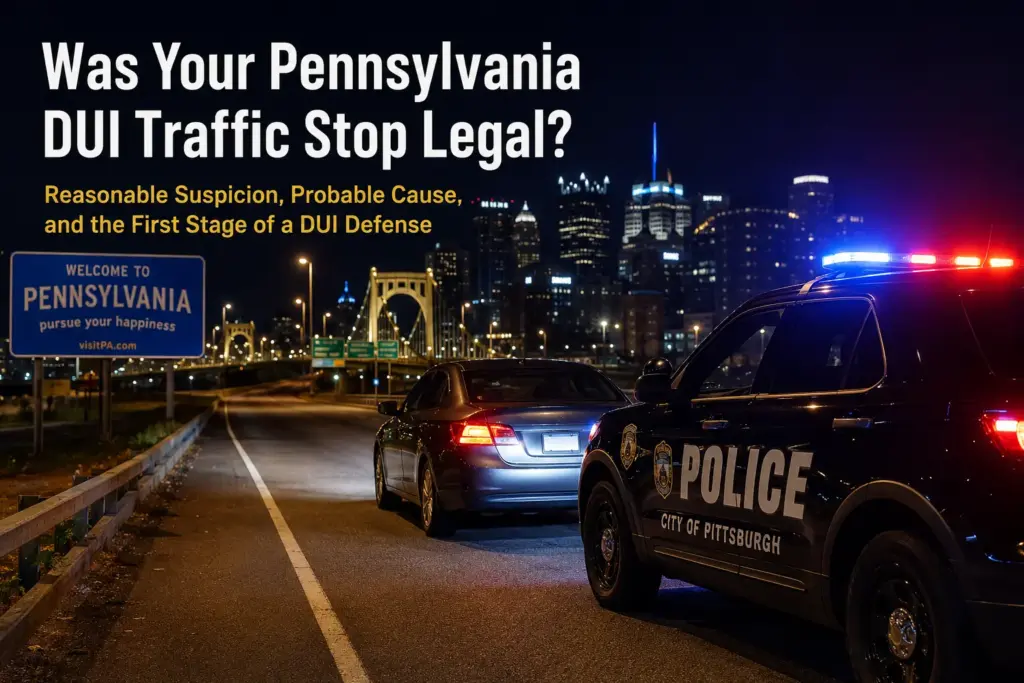
A driving under the influence case often begins before field sobriety testing, breath testing, or an arrest. It begins when a police officer activates emergency lights and directs a driver to pull over.
That first decision matters. A traffic stop detains the driver, so police must have a lawful reason for it. An officer cannot stop a vehicle simply to investigate whether the driver might be impaired. The officer must identify facts that meet the legal standard for the stop.
In Pennsylvania, reasonable suspicion or probable cause may provide that legal basis. The correct standard depends on why the officer stopped the vehicle. It also depends on whether the officer needed to investigate a suspected violation.
Anyone charged with driving under the influence should consider the legality of the stop. The police report may explain the officer’s reason, but it does not always tell the complete story. Dashboard camera footage, body-worn camera footage, dispatch recordings, and road conditions may show what happened before the detention.
Why the Traffic Stop Matters in a DUI Case
Once an officer approaches a stopped vehicle, the officer begins gathering information.
The officer may claim to notice an odor of alcohol or cannabis. The officer may also report bloodshot eyes, unusual speech, difficulty producing documents, or open containers. Police often describe these observations as signs of possible impairment.
The officer may ask where the driver has been. The officer may also ask whether the driver consumed alcohol or controlled substances. In many cases, the officer will request field sobriety exercises.
Prosecutors may later use those observations and statements to support an arrest. They may also present them as evidence in court.
The initial stop matters because police may not have discovered that evidence without the detention. When the officer lacked the required legal justification, a defense attorney may ask the court to suppress evidence that followed.
Suppression does not automatically resolve every case. The result depends on what evidence the court excludes and what evidence remains. Still, suppression can significantly affect a case that depends on roadside observations and testing.
Courts sometimes refer to this principle as the exclusionary rule or the fruit of the poisonous tree doctrine. PKN Law provides more detail in its article about how unlawfully obtained evidence may be challenged in court.
Reasonable Suspicion and Probable Cause Are Not the Same
Pennsylvania law does not apply one standard to every traffic stop.
Under Section 6308 of the Pennsylvania Vehicle Code, an officer may stop a vehicle when reasonable suspicion suggests a Vehicle Code violation. Pennsylvania appellate courts also consider the nature of the suspected violation. That distinction determines whether reasonable suspicion will suffice or whether the officer needs probable cause.
When Reasonable Suspicion May Apply
Reasonable suspicion may support a stop when the officer needs more information. Suspected impaired driving provides a common example.
An officer may observe unusual driving but still need to speak with the driver. Fatigue, distraction, a medical issue, or impairment could explain the conduct. The officer may use the stop to investigate which explanation fits the circumstances.
Reasonable suspicion requires specific and articulable facts. An officer cannot rely only on an unsupported feeling or hunch.
Courts consider the totality of the circumstances. They review what the officer observed, how long the conduct continued, and what happened on the roadway.
When Probable Cause May Apply
Probable cause sets a higher standard. It generally applies when an officer claims to have already witnessed a completed traffic violation. In that situation, the stop does not help the officer determine whether the violation occurred.
Speeding provides a useful example. An officer who claims that a driver was speeding usually does not need a stop to investigate the vehicle’s prior speed. The alleged violation has already occurred. Pennsylvania courts have therefore applied probable cause to stops based on speeding.
The distinction matters because police reports often use broad language. A report may not clearly identify the legal basis for the stop.
A careful review should identify what the officer claims to have observed. It should also identify the Vehicle Code provision at issue. The facts must satisfy the correct legal standard.
PKN Law discusses these principles further in its article about reasonable suspicion and probable cause during police encounters.
Common Reasons Police Give for a DUI Traffic Stop
Police may cite speeding, lane movement, defective equipment, failure to signal, or unusually slow driving. They may also identify another traffic concern.
The stated reason should not end the review. Available evidence may support, clarify, or contradict the officer’s account.
Weaving or Lane Movement
Police reports often mention weaving in driving under the influence cases. Repeated or unsafe movement across lane markings may support reasonable suspicion.
A brief movement within a lane may carry less weight. Road construction, poor weather, damaged pavement, or debris may explain the movement. Another vehicle may also force a driver to adjust position.
The length of the officer’s observation can matter. A report may state that a vehicle was weaving, yet video may show only a brief observation. Another recording may show repeated unsafe movement over several miles.
Similar wording in two reports can describe very different driving.
Defective Vehicle Equipment
An officer may claim that a taillight, brake light, license plate light, or turn signal did not work properly.
A defense review may ask whether the law required that equipment. It may also examine whether the equipment was actually defective. The officer’s viewing position and the surrounding lighting can matter as well.
Vehicle photographs may help. Repair invoices, inspection records, dashboard footage, and body-worn camera footage may also provide useful information.
Speeding
A stop based on speeding may raise questions about the measurement method. The officer’s location and distance from the vehicle may matter.
The review may also consider the equipment that the officer used. Nearby traffic could affect the reading in some situations. The available records should show how the officer reached the claimed speed.
Information From Another Person
An officer may rely on information from another officer, a dispatcher, or a civilian caller. Police do not always need to observe the reported conduct personally.
However, the information must carry enough reliability to support the stop. Courts may consider whether the caller identified themselves. They may also review the level of detail in the report.
A detailed report from an identified driver may carry more weight. The caller may describe dangerous conduct in real time and provide an accurate vehicle description.
A vague anonymous claim that someone might be intoxicated creates different concerns.
A Lawful Stop Does Not Make Every Later Action Lawful
A lawful initial stop does not give police unlimited authority to extend the detention.
A routine traffic stop allows the officer to address the reason for the stop. The officer may check the driver’s license, registration, insurance information, and outstanding warrants.
The United States Supreme Court addressed this issue in Rodriguez v. United States. The Court explained that police cannot extend a completed traffic stop for an unrelated investigation without additional legal justification.
Expanding the Stop Into a DUI Investigation
In a driving under the influence case, the officer may claim that new observations created reasonable suspicion. Those observations might include speech, odor, physical appearance, or difficulty handling documents.
Each observation deserves careful review.
An odor of alcohol may indicate consumption. It does not automatically prove impairment.
Bloodshot eyes can result from fatigue, allergies, irritation, or other causes. Nervousness often occurs during police encounters. A driver may struggle to locate a registration card because of stress or confusion.
The timing of these observations also matters. A defense attorney may examine when the officer completed the original traffic investigation. The attorney may also determine when the officer began asking about alcohol or controlled substances.
The officer needed sufficient grounds to extend the detention at that point.
Separate Legal Stages Require Separate Review
A DUI investigation often involves several stages.
First, the officer must justify the initial stop. Next, the officer must have a lawful reason to extend the detention. Finally, the officer must establish probable cause before making an arrest.
A lawful stop does not automatically make the later investigation lawful. It also does not automatically justify an arrest.
Evidence That May Show What Happened
The police report provides the officer’s written account. Other evidence may confirm it, add context, or contradict it.
Dashboard and Body-Worn Camera Footage
Dashboard camera footage may show the vehicle before the stop. It may reveal whether the driver crossed lane markings or committed a traffic violation.
The footage may also show whether the driver operated the vehicle as the officer described.
Body-worn camera footage can show the officer’s approach. It may capture the questions, answers, and roadside instructions. It can also show when the officer shifted from a traffic inquiry to a driving under the influence investigation.
Dispatch and Witness Evidence
Dispatch recordings may establish what information the officer received. These recordings often matter when another person reported the vehicle.
Witness information may also help. Another driver, passenger, nearby resident, or business employee may have observed part of the event.
Roadway and Vehicle Evidence
Roadway photographs may explain lane markings, lighting, construction, traffic controls, or visibility. Nearby cameras may have recorded part of the driving or stop.
Vehicle records can also matter. Repair documents and inspection records may address an alleged equipment problem.
Video does not always show every angle or capture every sound. Some recordings begin only after the officer first observes the vehicle. Even so, they can provide objective information that the report alone cannot offer.
Police departments and businesses may not preserve recordings indefinitely. Early legal review can help identify the available evidence. It may also allow counsel to request or preserve relevant records.
What Happens When a Driver Challenges the Stop?
A defense attorney may file a motion asking the court to suppress evidence. The motion may challenge an unlawful stop, detention, search, or arrest.
At a suppression hearing, the prosecution may present testimony and other evidence. The government will attempt to show that police acted lawfully.
The defense may question the officer. Counsel may identify inconsistencies, present relevant evidence, and argue that the facts did not satisfy the required standard.
The judge then decides whether the prosecution may use the challenged evidence.
If the court finds the stop unlawful, it may exclude evidence that resulted from the detention. The effect depends on the evidence at issue and the other facts in the case.
A challenge to the stop does not necessarily accuse an officer of bad faith. Constitutional rules apply even when an officer believes that the stop was proper. The court must decide whether the facts met the legal standard.
This analysis also differs from the question of impairment. The government must obtain its evidence lawfully before using it in a criminal prosecution.
Readers who want more information about the next stage can review PKN Law’s article about probable cause for a DUI arrest.
A DUI Stop Requires a Case-Specific Review
No single fact makes every traffic stop lawful or unlawful.
The answer depends on what the officer knew before activating the emergency lights. It also depends on what the officer intended to investigate and what the evidence shows.
A report that mentions speeding, weaving, or a defective taillight should not end the analysis. The relevant Vehicle Code provision may matter. Road conditions, video footage, officer testimony, and vehicle condition may also affect the review.
The sequence of events can prove especially important. The defense must determine when the officer observed each fact and when the investigation changed.
Patrick Nightingale has more than 24 years of criminal law experience. He has worked as both a prosecutor and a criminal defense attorney. That background helps him examine how the Commonwealth may justify a traffic stop and whether the evidence supports the officer’s account.
PKN Law represents people facing driving under the influence allegations in Pennsylvania. The firm provides more information on its Pittsburgh DUI defense page.
Someone charged after a questionable traffic stop can call PKN Law at (412) 454-5582 or request a confidential consultation. A review of the stop, video, police reports, and later investigation can identify issues that may affect the case.
This article provides general information and does not provide legal advice for any individual matter.
Frequently Asked Questions
Do Pennsylvania police need probable cause to make a DUI stop?
Not always. Reasonable suspicion may support a stop when an officer observes specific facts that suggest impaired driving. The officer may then investigate further.
Probable cause generally applies when the officer claims to have witnessed a completed traffic violation that needs no additional investigation.
Is weaving enough to justify a DUI stop?
It depends on how the vehicle moved and how often the movement occurred. The length of the officer’s observation also matters.
Repeated unsafe movement may support reasonable suspicion. A single minor movement may require closer review.
Can a broken taillight justify a traffic stop?
A defective taillight may justify a stop when the law requires the light and the officer has sufficient grounds to believe it is defective.
Video, photographs, inspection records, and repair documents may help evaluate the allegation.
Can police stop a driver based on an anonymous report?
An anonymous report can sometimes contribute to reasonable suspicion. Courts will examine its reliability.
The level of detail, timing, vehicle description, and police corroboration may all matter.
Does a legal traffic stop mean the DUI arrest was legal?
No. The initial stop, extended detention, and arrest involve separate legal questions.
Police must have sufficient justification at each stage.
What happens if the court finds that the stop was unlawful?
The defense may ask the court to suppress evidence obtained because of the unlawful stop.
The effect on the case depends on which evidence the court excludes and what admissible evidence remains.
What evidence should a DUI attorney review after a traffic stop?
Relevant evidence may include dashboard camera footage, body-worn camera footage, dispatch recordings, and police reports.
Roadway photographs, vehicle records, witness information, and chemical-testing documents may also matter.