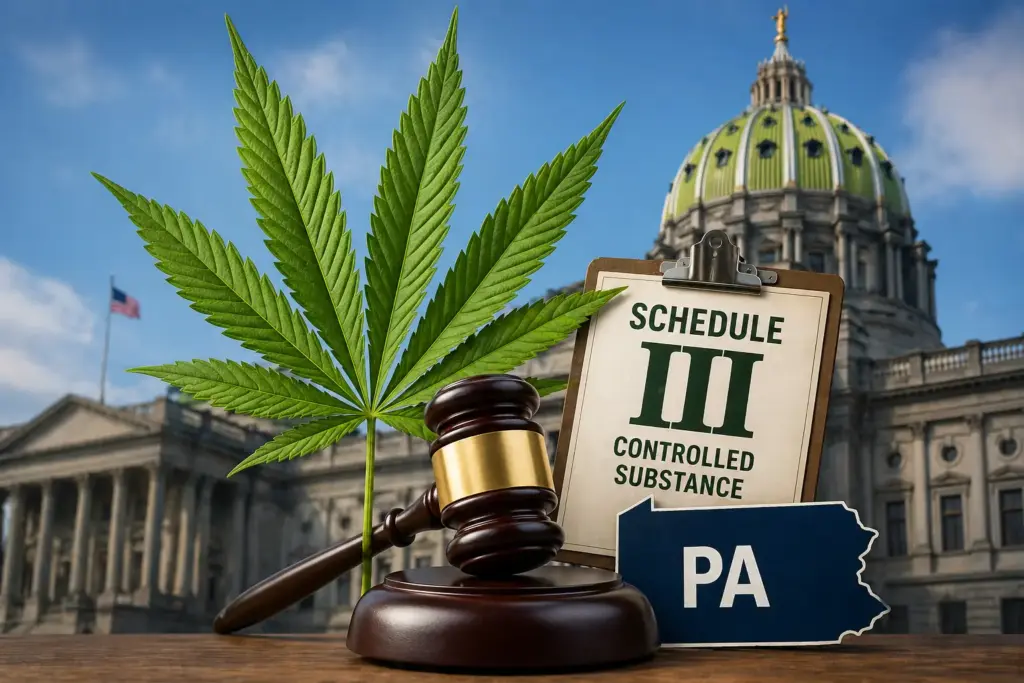
Cannabis rescheduling to Schedule III for FDA-approved cannabis products and marijuana products regulated by state medical marijuana programs may have significant consequences for Pennsylvania medical cannabis patients, DUI prosecutions, Second Amendment rights, taxation, research, and federal oversight.
The practical impact for Pennsylvania medical cannabis patients remains to be litigated, especially in cases involving medical cannabis DUI charges and firearm possession.
Key Takeaways
- Schedule I substances are treated as having no accepted medical use and a high potential for abuse.
- Schedule III substances have recognized medical benefits and a low to moderate risk of abuse or dependence.
- Rescheduling may reduce barriers to research.
- Rescheduling may provide tax relief to state-licensed medical cannabis companies under Section 280E.
- Rescheduling does not pardon or expunge cannabis convictions.
- Rescheduling does not automatically legalize interstate transportation of medical cannabis.
- Pennsylvania medical cannabis DUI cases may be affected.
- Pennsylvania medical cannabis patients’ Second Amendment rights may be affected.
- The DEA’s future role remains uncertain.
What Is the Difference Between a Schedule I Controlled Substance and a Schedule III Controlled Substance Under Federal Law?
A Schedule I Controlled Substance is classification under federal and that sets forth that a substance has no medical efficacy and a high rate of abuse.
Other Schedule I controlled substances include:
- Heroin
- LSD
- Psilocybin mushrooms
Interestingly, methamphetamine, cocaine, and fentanyl are Schedule II as they have been classified as having medical benefits despite also possessing a high potential for abuse.
Schedule III controlled substances have recognized medical benefits and a low to moderate risk of abuse and physical or psychological dependence.
Other Schedule III controlled substances include:
- Anabolic steroids
- FDA approved cannabis medicines such as Dronabinol
- Ketamine
- Barbiturates
- Buprenorphine, also known as Suboxone
- Tylenol with codeine
Why Was Cannabis Schedule I in the First Place?
That is a very good question, and the answer is incredibly frustrating given the millions of people whose lives have been upended or ruined due to a cannabis related criminal conviction.
Prior to the enactment of the Controlled Substance Act in 1970 cannabis possession was restricted by the Marihuana Tax Act of 1937 but not outright prohibited.
Then President Nixon and Congress were working on a comprehensive Controlled Substances Act to regulate all controlled substances and to criminally prohibit the possession and distribution of certain controlled substances in common use for their psychoactive properties.
Nixon’s motivations were called in to question by his chief domestic policy advisor John Erlichmann, who later said that the Administration knew that drugs weren’t the problem they were being made to be, but by criminalizing them Nixon had an excellent weapon to use against political adversaries such as the anti-war movement and black empowerment political organizations.
The Shafer Commission
Relative to the harms of cannabis use, President Nixon tapped former Republican Governor of Pennsylvania Raymond Shafer to lead a Commission to study the dangers of cannabis use and to recommend to Congress the appropriate category in which to place cannabis.
In the meantime, cannabis was temporarily placed in Schedule I.
Governor Shafer and his commission undertook a thorough review of the evidence of cannabis’ relative danger and harm as it existed to date.
It concluded that cannabis should not be scheduled comparing its use and abuse to alcohol use and recommending regulation as opposed to criminal prohibition.
This was completely inconsistent with Nixon’s aggressive public statements on cannabis, and the Shafer Commission report was buried.
Congress never received it or any other testimony regarding cannabis’ harm or dangerousness.
It remained Schedule I for any and all purposes until April 23, 2025.
What Happened?
During the Biden Administration then President Joe Biden called for the Drug Enforcement Agency, DEA, to conduct a review on whether cannabis should be rescheduled from Schedule I to Schedule III.
The Administration cited increasing medical acceptance of cannabis such as the Department of Housing and Human Services recommending rescheduling to Schedule III.
In May of 2024 the DEA called for public comment, receiving tens of thousands of comments.
But the process was shelved pending the incoming Trump Administration.
In December 2025, President Trump issued an Executive Order calling for the DEA to expedite the process of receiving public comment and proceeding with hearings on rescheduling.
But, in April 2026, the President directed Acting Attorney General Todd Blanche to use his authority to pursuant to the Single Convention on Narcotic Drugs to order federal rescheduling.
The Department of Justice Statement
The Department of Justice issued the following statement on April 23, 2026:
In accordance with President Trump’s December 18, 2025, Executive Order on Increasing Medical Marijuana and Cannabidiol Research, the Justice Department and the Drug Enforcement Administration, DEA, today announced the issuance of an order immediately placing both FDA-approved products containing marijuana and marijuana products regulated by a state medical marijuana license in Schedule III of the Controlled Substances Act, as well as the initiation of an expedited administrative hearing process to consider the broader rescheduling of marijuana from Schedule I to Schedule III.
Emphasis added.
Acting Attorney General Blanche said this:
“The Department of Justice is delivering on President Trump’s promise to expand Americans’ access to medical treatment options,” said Acting Attorney General Todd Blanche. “This rescheduling action allows for research on the safety and efficacy of this substance, ultimately providing patients with better care and doctors with more reliable information.”
DEA Administrator Terry Cole said this:
“Under the direction of President Trump and Acting Attorney General Blanche, DEA is expeditiously moving forward with the administrative hearing process — bringing consistency and oversight to an area that has lacked both,” said DEA Administrator Terry Cole. “Our men and women in law enforcement remain committed to fighting drug cartels, the fentanyl epidemic, and protecting American lives.”
It’s important to note that AG Blanche’s Order is limited to FDA approved cannabis derived medications, not sure why this was necessary as they were already Schedule III, and cannabis distributed through state legal medical cannabis programs.
I believe this is an important stance relative to state medical programs as we’ll discuss below.
What Does Rescheduling Do?
For the moment, it does a few things.
First, it requires medical cannabis operators in state legal medical cannabis programs to register with the DEA.
Second, it reduces cumbersome barriers to research.
For example, a university would have a very difficult time obtaining approval to research a Schedule I controlled substance.
Third, it allows state licensed medical cannabis companies tax relief under section 280 E of the Tax Code, which prohibits deducting operating costs from federal taxes.
What Does Rescheduling Not Do?
Rescheduling is not federal legalization, not by a long shot.
It remains illegal to possess any Schedule III controlled substance without a prescription from a DEA licensed physician or nurse practitioner.
Despite rescheduling, a Pennsylvania resident faces criminal prosecution for possessing cannabis outside of the provisions of Pennsylvania’s Medical Cannabis Act.
It does not:
- Provide any relief for any individual serving a federal prison sentence for cannabis offenses
- Pardon federal cannabis convictions
- Expunge federal cannabis convictions
- Permit interstate transportation of state medical cannabis
- Permit medical patient home cultivation in states that have legalized medical cannabis absent state specific provision permitting home cultivation
What Role Will the DEA Play Moving Forward?
That remains to be seen.
At the moment cannabis in medical cannabis states is the only Schedule III controlled substance not to undergo clinical trials.
Will the DEA insist, for example, that every different strain undergo FDA trials?
Or will it take a lighter approach?
Here’s where the DOJ’s statement quoted above may be a sign of the DEA’s role.
The statement immediately places FDA approved cannabis medications and state medical cannabis products in Schedule III.
What that suggests to me is that every medical cannabis product sold in the Commonwealth of Pennsylvania from April 23, 2026, onward is Schedule III federally.
Whether AG Blanche’s Order will be applied retroactively is unknown at present.
But as of the drafting of this blog every medical cannabis product lawfully possessed by a Pennsylvania medical cannabis patient is Schedule III.
What Effect Does This Have on Pennsylvania’s Controlled Substances Act Classifications?
A good question is whether this affects Pennsylvania’s Controlled Substances Act which currently places all cannabis in Schedule I, regardless of whether it is lawful under Pennsylvania’s medical cannabis laws.
I submit that between the Supremacy Clause of the United States Constitution and the Due Process Clause of the 14th Amendment Pennsylvania is Constitutionally prohibited from treating medical cannabis as a Schedule I controlled substance.
The Supremacy Clause says that no state law may supersede federal law.
A state cannot criminalize activity that the federal government permits.
Neither can a state legalize what federal law prohibits, with state legal cannabis programs being a notable exception.
Additionally, the Due Process Clause require states to give their citizens all the rights enumerated in the Bill of Rights and the Amendments to the Constitution.
Simply stated, a state can grant their citizens more rights than are guaranteed by the Constitution but cannot give less rights.
Maintaining Schedule I classification in the face of federal rescheduling would be violative of both.
What Does This Mean for Pennsylvania Medical Cannabis Patients?
Two issues that immediately come to mind are:
- Medical cannabis DUI arrests and prosecutions
- The Second Amendment rights of Pennsylvania medical cannabis patients
Medical Cannabis DUI Arrests and Prosecutions in Pennsylvania
Relative to DUI enforcement, it remains illegal to drive impaired by a prescribed Schedule III controlled substance.
At present, however, in Pennsylvania proof of impairment is not required if a motorist has any detectable amount of a Schedule I controlled substance in their body or its metabolites.
For Pennsylvania patients, this means that a patient can be arrested, prosecuted, and convicted of DUI for the mere presence of non-psychoactive metabolites with no proof of actual impairment required.
Given DOJ’s language recognizing that state regulated medical cannabis is Schedule III I believe that all MMJ DUIs fall under the prescription medication section of PA’s DUI statute requiring proof of actual impairment.
THC blood levels will certainly be admissible, but at least the patient motorist can present evidence to rebut the charge that he or she was too impaired to operate a motor vehicle.
Medical Cannabis and Second Amendment Rights in Pennsylvania
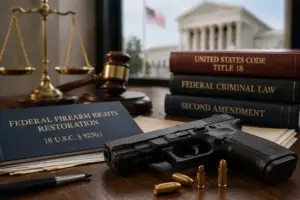
Turning to Second Amendment rights, federal law makes it clear that no one who is an “unlawful user of a controlled substance” may possess a firearm.
For states like Pennsylvania that mandate background checks when purchasing a firearm from a federally licensed firearms dealer, ATF Form 4473 sets forth that federal law does not recognize any state legal cannabis laws.
But as of April 23, 2026, state regulated medical cannabis is federally legal to possess as a Schedule III controlled substance.
This tells me that s Pennsylvania medical cannabis patient in lawful possession of medical cannabis pursuant to Pennsylvania’s Medical Cannabis Act is a lawful user of a Schedule III controlled substance under federal law.
In other words, I am of the opinion that a PA MMJ patient may lawfully possess and acquire a firearm and may lawfully obtain a concealed carry permit if otherwise eligible pursuant to Pennsylvania’s Uniform Firearms Code.
What’s Next?
The DEA will be holding hearings on whether all cannabis should be rescheduled to Schedule III beginning on June 29, 2026.
We have yet to litigate DUI or Second Amendment issues in Court, and it is unknown what position the Commonwealth will take.
Now that medical cannabis is Schedule III will worker’s compensation providers be required to cover the costs of medical cannabis as it would any other prescription drug?
Will the DEA he “hands on” or “hands off”?
What about medical patients in federally subsidized housing?
Will they be protected?
Will rescheduling be made retroactive for those with pending DUIs from lawful medical cannabis use?
Stay tuned!
Patrick K. Nightingale, Esq.
PKN Law
www.patricknightingale.com
FAQs About Cannabis Rescheduling and Pennsylvania Medical Marijuana
Is cannabis now federally legal?
No. Rescheduling is not federal legalization, not by a long shot.
Does rescheduling mean Pennsylvania residents can possess cannabis outside the Medical Cannabis Act?
No. Despite rescheduling, a Pennsylvania resident faces criminal prosecution for possessing cannabis outside of the provisions of Pennsylvania’s Medical Cannabis Act.
Can Pennsylvania medical cannabis patients still be charged with DUI?
Yes. Relative to DUI enforcement, it remains illegal to drive impaired by a prescribed Schedule III controlled substance.
Does Pennsylvania currently require proof of impairment in medical cannabis DUI cases?
At present, in Pennsylvania proof of impairment is not required if a motorist has any detectable amount of a Schedule I controlled substance in their body or its metabolites.
Could rescheduling affect Pennsylvania medical cannabis DUI cases?
Yes. Given DOJ’s language recognizing that state regulated medical cannabis is Schedule III I believe that all MMJ DUIs fall under the prescription medication section of PA’s DUI statute requiring proof of actual impairment.
Does rescheduling automatically expunge federal cannabis convictions?
No. It does not pardon or expunge federal cannabis convictions.
Does rescheduling permit interstate transportation of state medical cannabis?
No. It does not permit interstate transportation of state medical cannabis.
Does rescheduling allow Pennsylvania medical cannabis patients to grow cannabis at home?
No. It does not permit medical patient home cultivation in states that have legalized medical cannabis absent state specific provision permitting home cultivation.
Can a Pennsylvania medical cannabis patient possess a firearm?
In my opinion, a PA MMJ patient may lawfully possess and acquire a firearm and may lawfully obtain a concealed carry permit if otherwise eligible pursuant to Pennsylvania’s Uniform Firearms Code.
What are the biggest unanswered questions after rescheduling?
Some of the biggest unanswered questions include:
- Will the DEA be hands on or hands off?
- Will worker’s compensation providers be required to cover medical cannabis?
- Will medical patients in federally subsidized housing be protected?
- Will rescheduling be made retroactive for pending DUIs from lawful medical cannabis use?
- What position will the Commonwealth take in DUI and Second Amendment litigation?