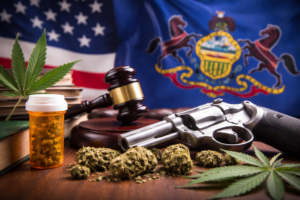

If you use cannabis in Pennsylvania, including as a registered medical marijuana patient, you may assume your firearm rights are protected. Pennsylvania law and federal law do not always align.
That gap can create serious legal risk for otherwise law abiding people. This article explains the difference between Pennsylvania rules and federal firearm rules, why Title 18 United States Code Section 922(g)(3) matters, and what practical steps can reduce exposure. It is written for Pennsylvania residents who want clear answers without legal jargon.
Quick Summary for Pennsylvania Cannabis Consumers
-
Pennsylvania law does not automatically remove firearm rights solely because someone is a cannabis consumer or a registered medical marijuana patient.
-
Federal law can still treat cannabis use as a basis to prohibit firearm possession under Title 18 United States Code Section 922(g)(3).
-
A person can be compliant with Pennsylvania medical marijuana rules and still face federal firearm exposure.
-
Courts have been reviewing constitutional challenges to Section 922(g)(3) in some cases, but the statute can still be used for arrests and charges.
-
If you have questions about your specific situation, schedule a confidential consultation with PKN Law at (412) 454-5582 or patricknightingale.com/.
The Core Problem: State Law and Federal Law Do Not Match
Pennsylvania has a regulated medical marijuana program. Many patients follow the rules, maintain valid identification, and purchase through approved dispensaries. From a state law perspective, they feel compliant.
Federal law treats marijuana differently. Under federal law, marijuana is still a controlled substance. That classification drives federal firearm restrictions, even when a person is lawful under Pennsylvania medical marijuana rules.
This mismatch is the heart of the problem. A Pennsylvania resident can be doing what the Commonwealth allows while still triggering federal firearm risk.
Pennsylvania Law: What the Commonwealth Generally Allows
Pennsylvania firearms law, including the Uniform Firearms Act, does not automatically label a person as prohibited solely because the person uses cannabis or holds a medical marijuana card.
In practical terms, that often means:
-
A medical marijuana patient is not automatically barred under Pennsylvania law from owning a firearm solely due to patient status.
-
A cannabis consumer is not automatically disqualified under Pennsylvania state law from applying for a license to carry a firearm solely due to cannabis use.
Important note: This does not mean every person will qualify for a license to carry a firearm. Other disqualifiers can still apply, including certain convictions, active warrants, protection from abuse orders, and other statutory restrictions. The key point is that cannabis patient status alone is not the same thing as a Pennsylvania firearms prohibition.
Federal Law: Why Cannabis Can Create Firearm Exposure
Federal firearms law includes a list of categories of people who are prohibited from possessing firearms. One category includes an unlawful user of or addicted to a controlled substance.
That language appears in:
-
Title 18 United States Code Section 922(g)(3)
Because marijuana remains a controlled substance under federal law, federal authorities can treat cannabis use as unlawful use for purposes of firearm possession restrictions.
What is the penalty exposure under federal law?
Federal penalties can be severe. Depending on the charge and the facts, a person can face significant prison exposure, long term firearm restrictions, and lifelong consequences related to employment and professional licensing.
If you are unsure how these rules apply to you, do not guess. The safest approach is to talk with a defense lawyer before a purchase, a carry decision, or any situation where law enforcement contact is likely.
Where People Get Tripped Up: Firearm Purchases and Federal Background Checks
A common risk point is purchasing a firearm from a federally licensed firearms dealer. Those purchases involve a federal background check process and a federal form that asks about drug use, including marijuana.
This creates two major problems for cannabis consumers:
-
If you disclose cannabis use, the purchase may be denied.
-
If you do not disclose cannabis use and the government later claims the answer was false, the government may pursue additional allegations beyond firearm possession.
This is one reason the state law versus federal law conflict matters so much. State permission does not control the federal purchase process.
Possession Versus Impairment: Why This Is Not Just About Being High
Many people assume the issue is only about being under the influence while handling a firearm. Section 922(g)(3) is not written that way. It does not require the government to prove you were impaired at the time you possessed a firearm.
Instead, cases often focus on whether the government claims the person is an unlawful user. Evidence the government may use can include:
-
Statements to law enforcement
-
Social media posts
-
Text messages
-
Marijuana found during a search
-
Paraphernalia located in a home or vehicle
-
Prior drug related arrests
-
Drug testing results
-
Dispensary records in some situations
Every case is fact specific. Some investigations are based on weak evidence or assumptions. Others arise because a person tried to be cooperative and said too much. If you are contacted by law enforcement about firearms or cannabis, it is usually best to speak with counsel before making statements.
Why This Feels Confusing and Unfair
Many registered medical marijuana patients followed Pennsylvania rules, obtained physician certifications, and use cannabis in a controlled, responsible way. They may have no history of violence and no criminal record. Federal law can still treat them as prohibited for firearm purposes. That is why this issue surprises people. The conduct feels lawful, but the federal framework still creates exposure. The worst time to learn about this conflict is after a traffic stop, a search, or a domestic call where firearms are present and questions are asked.
Constitutional Challenges: Courts Are Reviewing Section 922(g)(3)
Section 922(g)(3) has been challenged in federal courts, including challenges focused on how it applies to cannabis consumers. Some courts have found the statute unconstitutional in certain circumstances, particularly where there is no history of violence and the government cannot show a traditional historical basis for broad disarmament based on cannabis use alone.
Other courts have ruled differently. The law is evolving and outcomes can vary by jurisdiction and by facts.
The practical takeaway is simple:
-
Even when a statute is being challenged, people can still be arrested and charged under it.
-
A strong defense may involve both case specific facts and constitutional arguments, depending on the situation.
If you are facing investigation or charges that involve firearms and cannabis, you need a strategy built for the facts of your case and the current legal landscape.
Practical Risk Reduction for Pennsylvania Cannabis Consumers
This is not personal legal advice. It is a practical checklist of common risk areas that people should understand.
Situations that can increase exposure
-
Purchasing a firearm through a federally licensed firearms dealer while using cannabis
-
Carrying a firearm during a traffic stop where cannabis is present
-
Keeping firearms in a home where cannabis is stored and the home is searched
-
Posting cannabis use publicly on social media while also posting firearms
-
Making statements about cannabis use to law enforcement
-
Mixing cannabis use with other allegations that draw federal attention
What to do if you are unsure
-
Talk with a criminal defense lawyer before a purchase or carry decision that could create federal exposure
-
Avoid making statements to law enforcement about cannabis use without counsel
-
If you are charged or investigated, get legal advice immediately and do not attempt to explain your way out of it
To discuss your specific circumstances confidentially, schedule a consultation with PKN Law at (412) 454-5582 or patricknightingale.com/.
Why Working With a Former Prosecutor Matters in These Cases
Firearm cases often turn on details. Cannabis related allegations can add another layer of complexity, especially when federal statutes are involved. As a former prosecutor and long time defense attorney, I understand how the government builds these cases and where the weak points often are. A careful defense approach may include:
-
Challenging the basis for the stop, search, or seizure
-
Challenging whether the evidence supports the label of unlawful user
-
Examining whether statements were obtained lawfully
-
Evaluating constitutional defenses when appropriate
-
Negotiating to reduce exposure when the facts support it
-
Preparing for trial when necessary
Frequently Asked Questions About Cannabis and Gun Rights in Pennsylvania
Can I own a firearm in Pennsylvania if I have a medical marijuana card?
Pennsylvania law does not automatically prohibit firearm ownership solely because you are a registered medical marijuana patient. Federal law can still create risk based on cannabis use.
Can I carry a firearm in Pennsylvania if I use cannabis?
Pennsylvania law may not automatically prohibit you based solely on cannabis use, but federal law can still treat cannabis users as prohibited persons. The risk depends on the facts and circumstances.
Can I buy a firearm from a gun store if I use cannabis?
Purchasing from a federally licensed firearms dealer involves federal rules and a federal background check process. Cannabis use can create issues under federal law during that process.
Can I be charged federally even if I follow Pennsylvania medical marijuana rules?
Yes. A person can be compliant with Pennsylvania medical marijuana rules and still face federal firearm exposure under Title 18 United States Code Section 922(g)(3), depending on the circumstances.
Is Section 922(g)(3) unconstitutional?
Some courts have found Section 922(g)(3) unconstitutional in certain circumstances, while other courts have upheld it. The law is evolving, and outcomes can vary by jurisdiction and facts.
What should I do if the police ask me about cannabis and firearms?
It is usually best to avoid making statements and to speak with a lawyer before answering questions. Statements can be used as evidence later.
Talk to PKN Law About Your Specific Situation
If you are a cannabis consumer in Pennsylvania and you have concerns about firearm ownership, carrying, or a pending investigation, you do not have to figure this out alone. Getting advice early can prevent mistakes that become criminal charges.
To schedule a confidential consultation, contact PKN Law at (412) 454-5582 or visit patricknightingale.com/.