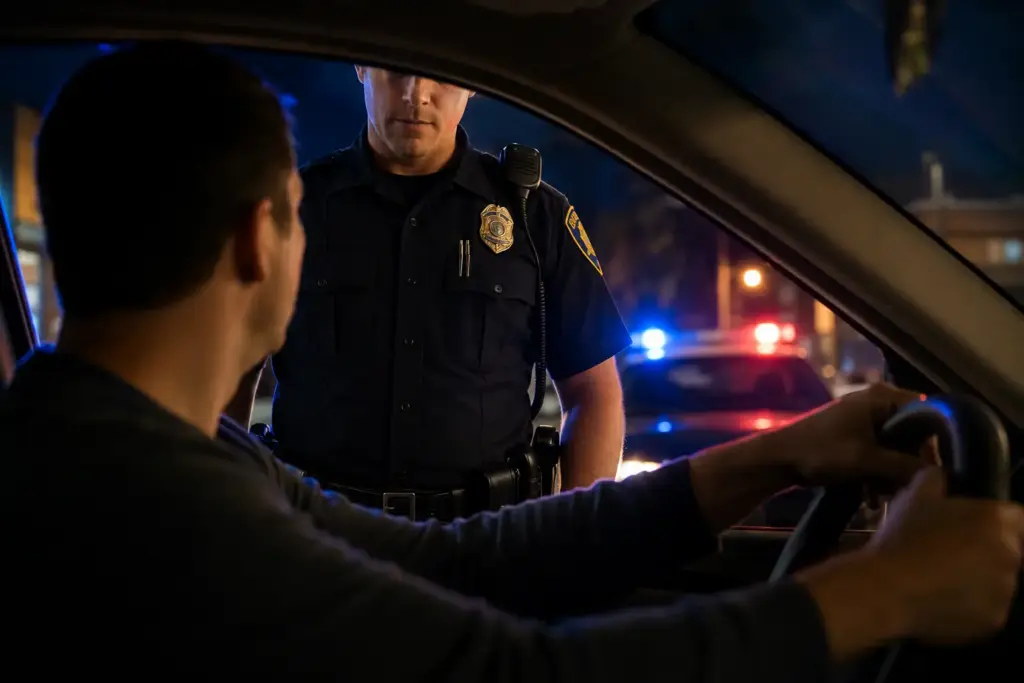
A police officer asks a simple question during a traffic stop: “Have you had anything to drink tonight?”
Many drivers believe the safest response is to admit to a small amount. They may say they had only one beer, two drinks with dinner, or a glass of wine several hours earlier. The driver may hope that cooperation will reassure the officer and bring the encounter to a quick end.
That is not necessarily what happens.
An admission that you consumed alcohol can become part of the officer’s justification for continuing a driving under the influence investigation. The statement may be considered alongside the reason for the stop, the time of night, the odor of alcohol, the driver’s appearance, speech, coordination, driving behavior, and performance on roadside exercises.
This does not mean a person should lie to the police. Lying can create additional legal and practical problems. It does mean that Pennsylvania drivers should understand the difference between providing required information and voluntarily answering questions that may be used as evidence.
The better question is not whether “two drinks” sounds innocent. The better question is how that statement may affect the investigation that follows.
Why an Admission About Drinking Can Matter
When an officer approaches a vehicle, the officer is gathering information. Some information comes from direct observation. Other information comes from the driver’s answers.
A statement such as “I only had two beers” may appear limited, but it still confirms alcohol consumption. Depending on the circumstances, the officer may use that admission to support additional questioning, request roadside testing, administer a preliminary breath test, or continue detaining the driver while investigating possible impairment.
The word “only” does not prevent the statement from being used as evidence. Police reports often document a driver’s exact or approximate admission, including what the person drank, where the drinking occurred, when the last drink was consumed, and how many drinks the person claims to have had.
Those details may later be compared with breath or blood test results. Prosecutors may also argue that the admission supports the officer’s observations or explains alleged signs of impairment.
A driver should not assume that admitting to a small amount will persuade an officer to end the stop. Once alcohol consumption is confirmed, the investigation may become more focused rather than less focused.
Pennsylvania DUI Law Does Not Require Extreme Intoxication
Some drivers mistakenly believe that a driving under the influence charge requires obvious drunkenness or a very high blood alcohol concentration.
Pennsylvania law is broader.
Under Pennsylvania’s driving under the influence statute, a person may be prosecuted under a general impairment theory when alcohol has rendered the person incapable of safely driving, operating, or being in actual physical control of a vehicle. The statute also establishes blood alcohol concentration categories, beginning at 0.08 percent for most adult drivers. Lower thresholds apply to certain drivers, including minors and drivers operating commercial or school vehicles.
This distinction matters because the Commonwealth does not always need a blood alcohol concentration of 0.08 percent or higher to pursue a case. A general impairment charge may rely on officer observations, driving behavior, statements, video recordings, witness accounts, roadside testing, and other evidence.
A person’s description of having “just a couple” of drinks may therefore become relevant even when the chemical test result is disputed, unavailable, below 0.08 percent, or excluded from evidence.
The number of drinks alone does not establish whether someone was impaired. Alcohol affects people differently based on factors such as body composition, food consumption, timing, drink size, alcohol concentration, medications, fatigue, and individual metabolism. A mixed drink poured at a bar or private gathering may also contain more alcohol than the person assumes.
For these reasons, neither the driver nor the officer can reliably determine legal impairment merely by counting drinks.
What Information Must a Driver Provide?
A driver who is lawfully stopped should remain calm, keep hands visible, and follow reasonable safety instructions. The driver will generally be expected to provide a driver’s license, vehicle registration, and proof of insurance.
Those document requests are different from investigative questions such as:
- Where are you coming from?
- Where are you going?
- Were you at a bar?
- Have you been drinking?
- How many drinks did you have?
- When did you have your last drink?
- Have you taken any medication?
- Is there anything illegal in the vehicle?
A driver should not argue, make sudden movements, or provide false information. At the same time, a person does not have to volunteer a detailed account of the evening merely because an officer asks.
A respectful response may be: “Officer, I would prefer not to answer questions.”
That response does not guarantee that the officer will end the investigation. It also does not prevent the officer from relying on independent observations. It does, however, avoid supplying an unnecessary admission that may later appear in a report or courtroom presentation.
The circumstances of a stop can change quickly, and the legal analysis may depend on whether the encounter remains an ordinary traffic detention or develops into the functional equivalent of an arrest.
Why You May Not Receive Miranda Warnings at the Roadside
People often believe that police must read Miranda warnings before asking any question that could produce an incriminating answer. That is not how the rule generally operates during an ordinary traffic stop.
Pennsylvania appellate courts have explained that a routine traffic stop is usually considered investigative rather than custodial for Miranda purposes. Whether the encounter becomes custodial depends on the totality of the circumstances, including the duration and conditions of the detention.
As a result, an officer may ask whether a driver has been drinking without first reading Miranda warnings. The driver’s answer may still be documented and potentially offered as evidence.
This is one reason drivers should not depend on the officer to announce when a question has legal consequences. A calm roadside conversation can still be part of an evidence-gathering process.
Whether a particular statement should be suppressed is a fact-specific legal question. Relevant considerations may include the nature of the detention, the officer’s words and conduct, the number of officers present, whether the driver was physically restrained, how long the questioning lasted, and whether a reasonable person would have felt free to leave.
An Admission Is Only One Part of a DUI Investigation
Saying that you consumed alcohol does not automatically establish driving under the influence. Police must consider the complete circumstances, and the Commonwealth must ultimately prove every required element of the offense.
Officers may document observations such as:
- The vehicle’s movement before the stop
- The reason the officer initiated the stop
- An alleged odor of alcohol
- Red, watery, or glassy eyes
- Slurred or unusual speech
- Difficulty locating documents
- Balance or coordination concerns
- Statements made by the driver or passengers
- Open containers or other items in the vehicle
- Performance on field sobriety exercises
- Results from breath or blood testing
- Dashboard camera or body-worn camera footage
Each observation should be examined carefully. Some alleged indicators of impairment can have innocent explanations. Fatigue, allergies, illness, anxiety, uneven pavement, poor lighting, physical limitations, footwear, weather, and confusing instructions may affect how a person appears or performs.
The legality of the initial stop also matters. PKN Law’s article addressing whether a Pennsylvania DUI stop was legal explains that an officer must have an adequate legal basis for detaining a vehicle. Evidence obtained after an unlawful stop may be subject to challenge.
The issue is not whether the officer wrote several observations in a report. The issue is whether those observations are accurate, supported by recordings or testimony, and legally sufficient.
Reasonable Suspicion and Probable Cause Are Different Standards
A driving under the influence investigation may involve several separate legal stages.
First, the officer needs a lawful basis for the traffic stop. That basis may involve an observed traffic violation or reasonable suspicion of criminal activity.
Next, the officer may need justification to expand the stop into a more detailed impairment investigation. An admission to drinking may be one fact considered at this stage, especially when combined with other observations.
Finally, an arrest requires probable cause. Probable cause is a higher standard than reasonable suspicion. It asks whether the known facts and circumstances would support a reasonable belief that an offense occurred.
PKN Law provides a more detailed explanation of probable cause in a driving under the influence arrest. That issue should be evaluated based on the entire sequence of events, not merely the officer’s ultimate conclusion.
An admission to one or two drinks is not automatically probable cause for arrest. It may nevertheless contribute to the officer’s stated basis for further investigation.
Roadside Breath Tests and Chemical Tests Are Not the Same
Drivers frequently use the phrase “breath test” to describe different procedures. That can lead to dangerous misunderstandings.
A roadside preliminary breath test is generally used as an investigative tool. It is different from an evidentiary chemical breath test requested after an arrest. A blood test is also subject to different legal and procedural considerations.
The consequences of refusing a test may depend on which test was requested, when it was requested, and whether the officer followed the required procedures.
Pennsylvania’s implied consent law provides for civil license consequences when a person who has been arrested for driving under the influence refuses a properly requested chemical test. Under Section 1547 of the Pennsylvania Vehicle Code, a qualifying refusal may lead to a driver’s license suspension. The statute also requires officers to provide specified warnings concerning the consequences of refusal.
A refusal does not necessarily prevent the Commonwealth from filing or prosecuting a driving under the influence charge. Prosecutors may attempt to rely on driving behavior, officer observations, statements, field sobriety exercises, video evidence, and other circumstances.
Because the legal consequences can be substantial, drivers should not assume that declining to answer questions and refusing chemical testing are the same decision. They are not.
PKN Law’s discussion of Pennsylvania implied consent and chemical test refusals provides additional information about this distinction.
What Should You Avoid Doing During the Stop?
A traffic stop is stressful, particularly when a driver believes the officer suspects alcohol or drug impairment. A person may speak too quickly, become defensive, or try to talk the officer out of an arrest.
Those reactions can create additional evidence.
Avoid arguing about the law on the roadside. Legal challenges are generally made later through counsel and the court process. Avoid guessing when asked how many drinks you consumed or when you consumed them. Avoid making jokes about drinking, medications, marijuana, or your ability to drive.
Do not lie. A fabricated answer may damage credibility and complicate the case.
Do not physically resist, interfere with the officer, or attempt to leave unless the officer clearly states that you are free to go.
A driver can be polite without volunteering an explanation. Remaining respectful and limiting answers are not inconsistent.
What If You Already Admitted to Drinking?
Many people admit to drinking before realizing that they had another option. That does not mean the case is over.
A statement must be evaluated in context. The defense may examine:
- What the driver actually said
- Whether the officer quoted the statement accurately
- Whether audio or video confirms the officer’s account
- Whether the questioning occurred during a lawful detention
- Whether the driver was in custody for Miranda purposes
- Whether the statement was voluntary
- Whether the officer had already decided to conduct testing
- Whether the remaining evidence supports impairment
- Whether chemical testing was reliable and legally obtained
The wording of the admission may also matter. “I had two beers” does not establish the size of the drinks, the alcohol content, the timing, the person’s blood alcohol concentration, or whether the person was incapable of safe driving.
Defense counsel should review the statement as one piece of the prosecution’s evidence rather than treating it as an automatic conviction.
How a Defense Attorney Reviews the Traffic Stop
A thorough driving under the influence defense begins with the complete timeline.
Counsel may review the dispatch information, reason for the stop, officer’s observations, questions asked, driver’s responses, field sobriety instructions, roadside test procedures, arrest decision, chemical testing request, warnings, test administration, laboratory records, and preservation of video evidence.
The review may reveal inconsistencies between the written report and the recording. It may show that instructions were unclear, observations were exaggerated, or the investigation was expanded without adequate legal justification.
In other cases, the central issue may involve chemical testing, medical conditions, the identification of the driver, actual physical control of the vehicle, or whether the Commonwealth can prove when the person last operated the vehicle.
Patrick Nightingale has more than 24 years of experience working as both a former prosecutor and criminal defense attorney. That background informs how PKN Law evaluates the prosecution’s evidence, identifies weaknesses, and prepares cases for negotiations, hearings, trial, or appeal.
Readers seeking broader information about representation can review PKN Law’s Pittsburgh driving under the influence defense practice.
A Careful Response Can Protect Your Position
There is no sentence that guarantees an officer will let a driver leave. There is also no universal script that addresses every circumstance.
The most practical approach is to remain calm, provide the required documents, follow lawful safety instructions, avoid lying, and avoid volunteering potentially incriminating details. A person can respectfully decline to answer investigative questions without becoming confrontational.
An admission that you consumed one or two drinks may seem minor. In a driving under the influence investigation, it may become one of the facts used to justify additional detention and testing.
Anyone charged after a traffic stop should preserve paperwork, avoid discussing the facts publicly, and seek advice promptly. To discuss a Pennsylvania driving under the influence charge with PKN Law, use the firm’s confidential consultation form or call (412) 454-5582. Legal options depend on the specific facts, and an individual case review can help identify the issues that deserve closer examination.
You should not lie to police during a Pennsylvania traffic stop, but you generally do not need to volunteer that you consumed one or two drinks. An admission may support further driving under the influence investigation. Remain respectful, provide required documents, and understand that chemical test refusal involves separate license consequences.
This article provides general legal information and does not create an attorney-client relationship. Laws and procedures may change, and the outcome of any case depends on its particular facts.
Frequently Asked Questions
Do I have to tell a Pennsylvania police officer that I was drinking?
You generally do not have to volunteer information about alcohol consumption during an ordinary traffic stop. You should provide required documents, comply with lawful safety instructions, and avoid lying. Whether a particular question must be answered can depend on the circumstances of the encounter.
Can I be arrested after admitting that I had only two drinks?
An admission to two drinks does not automatically establish probable cause for arrest. The officer may consider the statement with driving behavior, odor, appearance, speech, field sobriety exercises, testing, and other observations.
Should I say that I refuse to answer questions?
A driver may calmly state, “I would prefer not to answer questions.” The response should be respectful and should not interfere with providing required documents or complying with lawful instructions.
Do police have to read Miranda warnings before asking if I drank?
Usually not during an ordinary roadside traffic stop. Routine traffic stops are generally considered investigative rather than custodial. Miranda may become relevant if the detention develops into custody under the totality of the circumstances.
Is admitting to drinking the same as failing a breath test?
No. A statement about drinking is one piece of evidence. A preliminary roadside breath test and an evidentiary chemical breath or blood test are separate procedures with different purposes and legal implications.
Can I refuse a breath or blood test in Pennsylvania?
The consequences depend on the type of test and the circumstances. Refusing a properly requested chemical test after a qualifying driving under the influence arrest may result in a separate driver’s license suspension under Pennsylvania’s implied consent law.
Does a blood alcohol concentration below 0.08 percent prevent a DUI charge?
Not necessarily. Pennsylvania recognizes a general impairment offense that may be prosecuted based on evidence that alcohol rendered the driver incapable of safe operation, even when the Commonwealth does not rely on a blood alcohol concentration of 0.08 percent or higher.
What should I do after a Pennsylvania DUI arrest?
Keep all documents, write down what happened while your memory is fresh, preserve any relevant recordings or receipts, avoid public discussion of the case, and speak with a defense attorney who can review the stop, statements, testing, and arrest.